33707710
Apichat Pong Weerasethakuls film Uncle Boonmee who can recall past lives shows the shifts in cinematic aesthetics and subjectively have been discussed within this week’s readings mostly in context of post cinematic affect, relocation and the interplay of both emotion and affect. The film contains a meditative pace, dream like imagery and has engagement with its spiritual themes which challenge traditional cinematic convention and help immerse the audience in very deeply affective experience
Uncle Boonmee Who Can Recall His Past Lives’ – Review – The New York Times
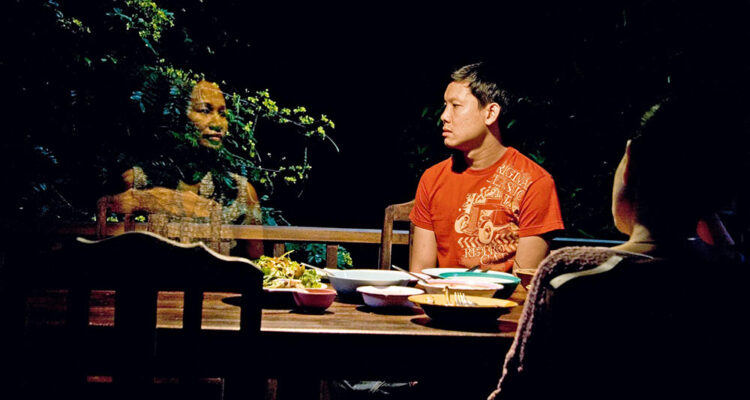
Steven Shaviros concept of post cinematic affect provides a lens for analysing Uncle Boonmee as it helps distinguish affect from emotion, empathising pre conscious responses that are evoked by contemporary audio visual media(2010, p.3.) This film contains a surreal blend of mystical and the mundane such as the appearance of the ghost of boonmees wife but also the monkey spirit that represents his deceased son which elicits a sense of unease that transcends conventional emotional engagement. These moments exemplify what Shaviro describes as the “immediate, immersive, and often overwhelming sensations” that characterize post-cinematic works (2010, p. 4).
Francesco Casetti’s notion of relocation also resonates within this film as Casetti argues that cinema has now moved beyond traditional theatres ( rip my childhood cinema- showcase cinema) and now into new spatial and cultural contexts. This is seen within Weerasethakul’s film which blends Thai folklore, Buddhist Philosophy and political history which in a sense embodies the relocation of cinema to spaces of cultural and spiritual hybridity. The jungle within the film serves as liminal space where the boundaries between life and death, human and non-human, and past and present dissolve showing that the now digital age operates within “new and complex environments” (2015, p.30)

Catherine Grant further discusses the “performative potential of audiovisual essays’ which offers another perspective to view this film in. This film in a sense can be viewed as an audiovisual essay as it explores themes of memory reincarnation and the ecological interconnectedness through experimental visual and narrative techniques. Grant highlights how audiovisual methods can convey knowledge and affect in ways that written texts cannot, which images viewers on an intuitive sensory level(2016). Similarly the director uses long takes combined with ambient sound and non linear storytelling to create an experience that feels more like a contemplative mediation rather than a conventional film.
Moreover within the film the lush jungle becomes a character in itself reflecting the film emphasis on the connection between humans and their environment. Sean Cubbits eco-critical perspective emphasises the role of digital media in redefining our relationship with the natural world and “challenge anthropocentric narratives.”(2013,p. 488). Through its depiction of reincarnation and the cyclical nature of life the film critiques linear, human-centered perspectives, offering instead a vision of existence that is fluid, relational, and deeply embedded in the natural world.

Casetti, F. (2015). The Lumière Galaxy: Seven Key Words for the Cinema to Come. Columbia University Press.
Cubitt, S. (2013). “Eco-Criticism and Eco-Aesthetics in the Age of Digital Media.” Textual Practice, 27(4), 487–504.
Grant, C. (2016). “The Audiovisual Essay as Performative Research.” NECSUS European Journal of Media Studies, 5(2), 171–193.Shaviro, S. (2010). Post-Cinematic Affect. Zero Books.
 Digital Audiovisual Media Class Blog
Leave a comment