As a form of audio-visual art, Music video has shifted its dissemination focus from TV to new media platforms with the rise of social media platforms such as YouTube and Tiktok. Compared with television, the dissemination scope of new media platforms is undoubtedly more extensive and centralized, which makes the audience’s acceptance of music videos have changed. This paper will take Rick Astly’s music video Never gonna give you up as an example to analyze how new media platforms affect audience acceptance forms and communication strategies.
This video has 1.5 billion views on YouTube, which is far beyond the creator’s deadline. Interestingly, the communication strategy of this video is not led by the creator, but by the audience’s self-dissemination as a meme and parody culture. People were encouraged to click through with various titles, but instead the music video appeared, and the parody was called Rickroll, but the origins of this online frenzy are widely debated.
It is hard to imagine this kind of transmission model appearing in the TV medium, and the transmission model recommended by the algorithm YouTube creates the soil for this kind of viral transmission. The emergence of Rickroll takes advantage of YouTube’s link sharing function to direct viewers to possible videos through “mischievous” links, forming a network phenomenon of user spontaneous transmission. However, these acts are not intended to convey the content of the video itself, as scholar Carol Vernallis (2013) said, “…reflecting the fragmentation trend of contemporary culture while connecting global audiences through creative forms.”
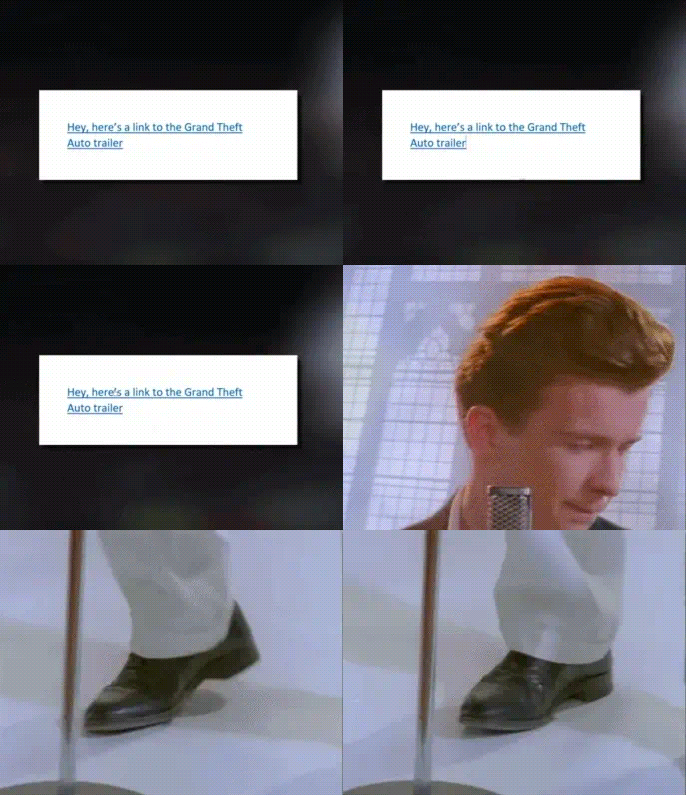
In addition, Carol (2013) also mentioned that on these platforms, music videos are no longer a supplement to “albums”, but become an important marketing concept for the production and consumption of visual culture. Users of Rickroll often achieve a sense of collective participation by disseminating this video, which is highly social behaviour. To a certain extent, this is due to the “coordination” feature of new media platforms, that is, platforms build a highly social community based on algorithms.
Therefore, the function of music videos in new media platforms is far greater than the music promotion itself, but is deconstructed as a meme or community discourse to build audio-visual culture. In the process of transmission, this is inevitably accompanied by the appropriation and secondary creation of the video itself, and then used for humor or to express other cultural demands. Like Carol’s analysis of Sick Puppies’ “It’s All the Same”, which saw its meaning reinterpreted as footage from the “Free Hugs movement”, achieved viral success and transformed its meaning into a social movement. The spread of Rickroll undoubtedly reflects the user participation attribute of the new media platform, as well as the potential to build a counterculture and let us see the potential of music video as an interactive art form in the digital age
Reference:
Thumim, N. (2012) ‘Introduction: Self-representation and Digital Culture’, Self-Representation and Digital Culture, pp. 1–18. doi:10.1057/9781137265135_1.
Vernallis, C. (2013) ‘Accelerated aesthetics’, The Oxford Handbook of Sound and Image in Digital Media, pp. 705–731. doi:10.1093/oxfordhb/9780199757640.013.013.
Vernallis, C. (2013b) ‘YouTube aesthetics’, Unruly Media, pp. 127–154. doi:10.1093/acprof:oso/9780199766994.003.0007.
By Xianglei Pang – 33832771
 Digital Audiovisual Media Class Blog
Leave a comment