How much have music videos evolved?
Music videos have been a part of the music industry for a very long period of time now, and it needs to be said how much they have evolved. Dating back to when MTV initially began displaying music videos on national television, the ever-growing nature of the technicality of music videos consequently resulted in the high level content produced nowadays. “The heyday of the purely televisual, MTV-style clip has long passed. Its once explicitly commercial imperative and well-defined aesthetic boundaries are now routinely changed and challenged by the emergent audiovisual economies of the internet.” (G. Arnold, 2017, p.172). As suggested by Arnold, the fact that the MTV style is still, to this day, being challenged, does none other than highlight how relevant it still is today, and how it has revolutionised music videos.
Enough about the MTV style, I want to focus more on how high the production value of music videos has grown in the last two centuries, mainly the era between 2010 – 2020. Katy Perry’s ‘Dark Horse’ is a great example. (K. Perry, Dark Horse, 2014). This music video, although only 3 minutes and 45 seconds, has an outstanding set design, costume design, prop design, CGI, and general production value. It also indulges in using high quality special effects. This video is a prime example of how music videos have evolved.
Furthermore, the video tells a story that somewhat goes in line with the lyrics. Katy Perry is an Egyptian queen with powers, and it seems as if she is looking for a king to marry, so various men present her gifts, and she eliminates all the ones she doesn’t. A perfect instance of how music videos can now be considered short films.
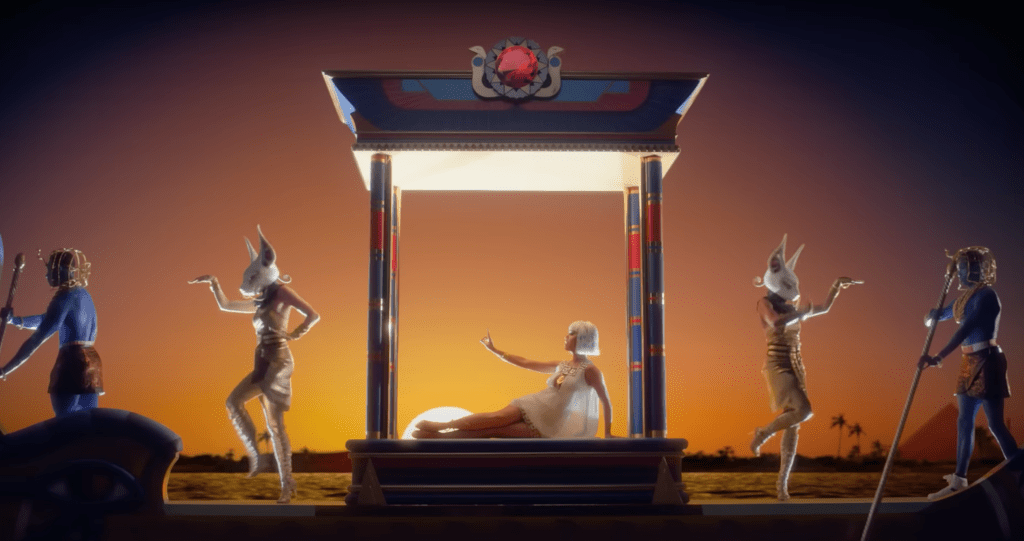
https://www.youtube.com/watch?v=0KSOMA3QBU0
“Time collapses into space. The linear thrust of traditional narration is replaced by the circular rhythms and repetitions of the camera’s roving eye—and, indeed, of the music” (S. Shaviro, 2017, p.9) Although this theorist is referring to a different music video, the reason for which I quoted this particular phrase is because it insinuates the incredible work that goes behind a music video, and how large the production value is. Shaviro cites many music videos and analyses every last detail of the cinematic work that goes behind it, including Rhianna’s ‘Disturbia‘ Rihanna appears in several iterations in the course of the video. In one guise, she seems to be the director of the asylum; the rest of the time, she appears as one or another imprisoned patient”(S. Shaviro, 2017, p.11) Once again, suggesting the location changes, costume changes, overall emphasising the high production value.
Ending on the notion that I can confidently say that music videos have now evolved into a new form of short film, just a more melodic style.
- Alessandro A. Conzonato
Bibliography:
Gina Arnold, 2017, The Persistence of the Music Video Form from MTV to Twenty-First-Century Social Media’, Music/Video: Histories Aesthetics
Katy Perry, 2014, Dark Horse, Vevo
Steven Shaviro, 2017, ‘Glitch Aesthetics’, Digital Music Video. Rutgers University Press
 Digital Audiovisual Media Class Blog
Leave a comment