Jurassic Park (1993) is one of the milestones in film history, and its innovation in digital animation technology not only promoted the development of the film industry, but also had a profound impact on the future of film production. The film was the first successful use of computer-generated imagery (CGI) combined with traditional live action shooting to bring dinosaurs to life in front of the audience, ushering in a new era of digital special effects.
Before that, creatures in movies were mostly realized with mechanical models or makeup effects. However, director Steven Spielberg worked with Industrial Light & Magic (ILM) to bring digital animation technology to the production of dinosaurs. They used CGI to create realistic, dynamic scenes of dinosaurs, such as a raptor running and a T-rex roaring. This dynamic representation goes far beyond the physical limitations of traditional models, allowing the audience to feel the real presence of dinosaurs on screen for the first time.
One of the most iconic CGI scenes in the film is when the T-Rex escapes at night. Despite the use of hybrid technology (mechanical dinosaurs combined with CGI), the CGI part seamlessly integrates the complex rain environment, light effects and the dynamics of the dinosaurs, making the whole picture full of tension. This is not only a technical achievement, but also an innovation in visual language.
But instead of relying entirely on CGI, it combines digital technology with mock-ups from Stan Winston’s studio to create a more visually realistic effect. For example, the skin texture and muscle movement of the dinosaurs in close-up shooting are all very fine through mechanical models, while the distant action scenes are completed by CGI. This combination not only optimized the production cost, but also made up for the lack of CGI in detail performance, forming the “hybrid” trend of film special effects.
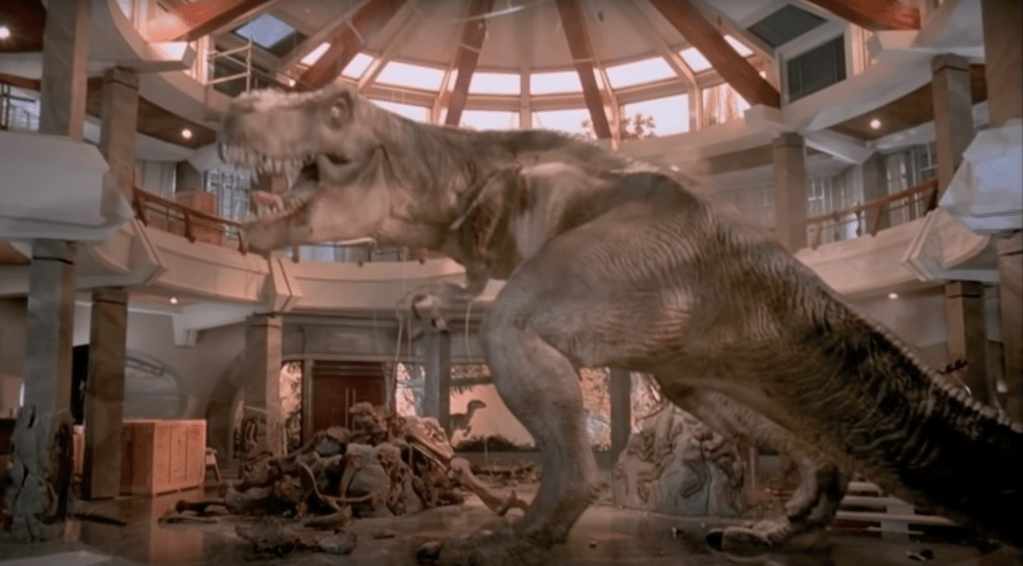
The success of Jurassic Park marked the film industry’s official entry into the digital age. The new technology developed by the ILM team became the industry standard, and CGI was adopted by more and more films. The film not only proved the feasibility of digital animation, but also demonstrated the great potential of its integration with traditional production methods, laying the foundation for subsequent digital blockbusters such as The Lord of the Rings and Avatar.
Manovich, L. 2002, ‘What is New Media’, The Language of New Media, pp.18-61
Shane Denson and Julia Leyda, ‘Perspectives on Post-Cinema: An introduction’, Post-Cinema: Theorising 21st Century Film, pp. 1-19
Xuping Yue 33814020
 Digital Audiovisual Media Class Blog
Leave a comment