Since the establishment of MTV in the 1980s until today, music videos have been influential because of their ability to mirror societal and cultural pulses and trends. Railton and Watson (2011) ‘consider the relationship between music video and cultural identity not simply as a straight unbroken line – as a litany of imposed subjectivities – but rather as a dialogic encounter between different identity positions which may variously be regressive or transformative, reactionary or progressive, nostalgic or yearning, and of course, accepted or rejected’. One of the most authentic music artists who uses his music videos to provoke dialogue and reflect on various important social issues is the Belgian musician Stromae.
One of Stromae’s videos that focuses on toxic societal dynamics is ‘Tous les mêmes’, released in December 2013, on YouTube. ‘Tous les mêmes’ is a powerful dance anthem that depicts stereotypical gender binaries of ‘male’ and ‘female’ behavior and how they affect our identities and relationships.
From the first scene, it is clear that the video is going to depict gender binaries in their most stereotypical form, representing them through color – the female as pink, and the male as green. Stromae’s face is stylized half-man and half-woman, and the side of his face we see corespodents to the gender he is portraying. When he is portraying the female lead the whole screen is dyed pink, and when he plays the male, the screen turns green. Although he plays the two roles, at the same time Stromae’s narrative persona is genderless, and we also see him as a critic, an outsider, a person who can provide an objective overview of the stereotypical identities and dynamics that are imposed on people. This is also shown in three dancing scenes, which are devoid of gendered colors, while the dance seems to be imitating the dynamic of conflict.
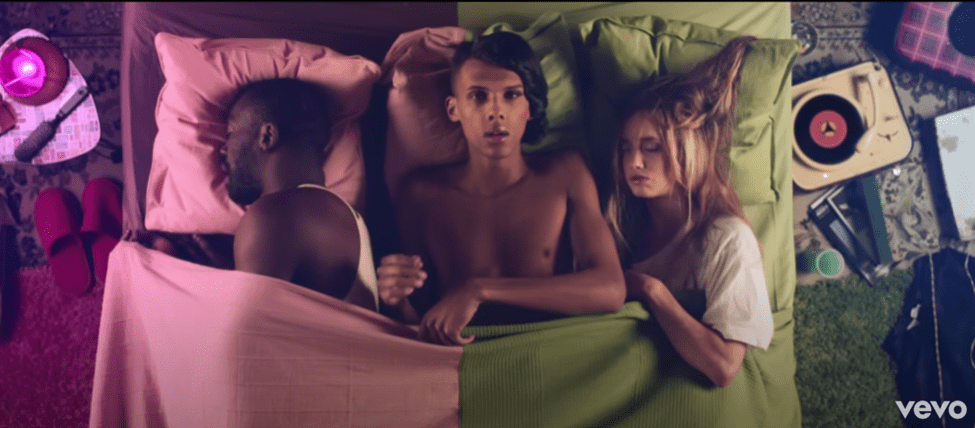
In its transitions the video is quite theatrical, resembling the logic of musicals and adding to the dramatic effect of the conflict it depicts. The cut used at 00:17 presents a coordinated transition, and this type of cut is used several times throughout the video to transfer Stromae from his male to his female character. Throughout the video, with rapid light switching, face turning, and using the emphasis ‘female’ and ‘male gesticulation’, we see the clash between the ‘male’ and the ‘female” world.
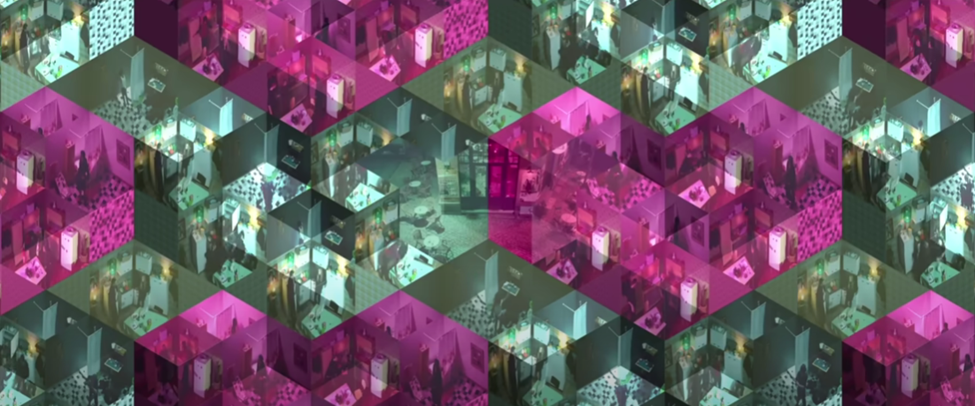
The video ends with lovers parting, and a kaleidoscopic image of the pink and green hearts – the male and female notions of love. The kaleidoscopic image consists of the same image of a couple in a kitchen repeating, but colored in different ways. ‘Tous les mêmes’ is a unique critique of the imposed stereotypes and binaries and represents a vibrant, yet, very powerful critique of the issue.
References:
Arnold, G., Cookney, D., Fairclough, K., & Goddard, M. (n.d.). Introduction: The persistence of the music video form from MTV to twenty-first-century social media. Music/Video: Histories, Aesthetics, Media, 1-14.
Railton, D., & Watson, P. (2011). Music video in black and white: Race and femininity. In Music video and the politics of representation (pp. 87-107).
Pitchfork. (2024, November 27). Stromae breaks down his music videos: Watch. Pitchfork. https://pitchfork.com/news/stromae-breaks-down-his-music-videos-watch/
Vernallis, C. (2013). Unruly media: YouTube, music video, and the new digital cinema. Oxford University Press.
Author: Marina Zec, 33839036
 Digital Audiovisual Media Class Blog
Leave a comment