33724037
Venus Pun
Rupaul Drag Race offers a crucial lens to examine the ever-evolving representation of sexuality, gender, and identity within television. This show has become a cultural phenomenon worldwide, having many spinoffs. Still, it is highly relevant when discussing how it challenges the boundaries of gender representation but also provides a unique space for non-binary, queer and trans voices, making it such a fitting example for analysing the “transiting” of television content.
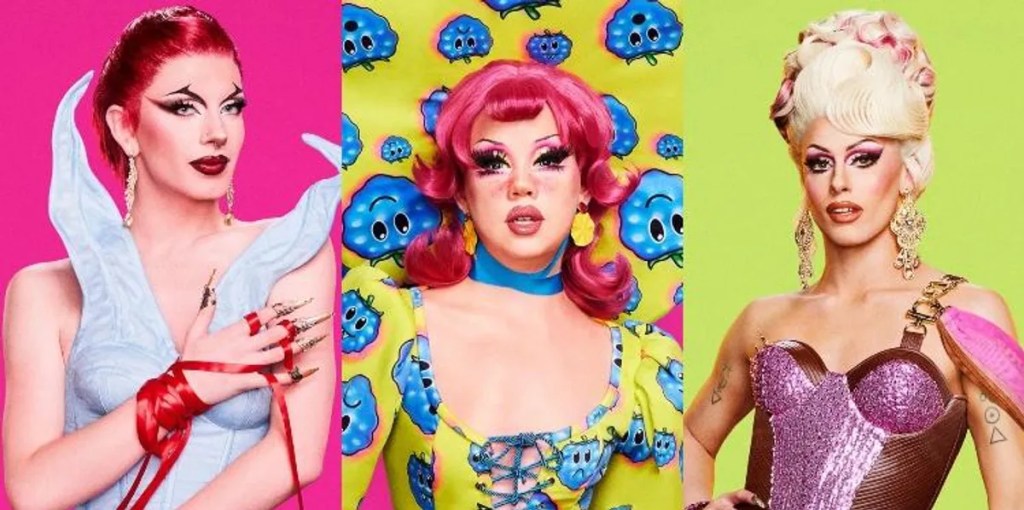
Michael Goddard and Christopher Hogg(2018) discuss how digital platforms have provided new possibilities for marginalised voices as they argue that Trans TV is “both a concept and intervention into contemporary television,” where media no longer just reflects but actively participates in the transformation on the views on gender which provides marginalised voices including trans and gender-non comforting individuals to be heard across the globe. It offers a stage for drag queens and performances that are gender-based and blur the lines between femininity and masculinity and everything in between.
“Transing” of television aesthetics, explored by Anamarija Horvat (2010), argues that contemporary LGBTQ+ TV provides a space for more fluid and diverse representations. While the show primarily focuses on drag culture, most specifically the art of transforming the contestant’s gender presentation through performance, it also integrates elements of nonbinary expression which further highlights the intersectionality of gender identity and sexuality which is seen. 2 contestants I would like to focus on this such, Peppermint and Carmen Carrera and their exploration of gender performativity is echoed within Horvat’s point that queer tv often deals with issues of immobility where characters are in a state of transition or flux. In addition, Goddard and Hogg(2020) note how the rise of platforms like Netflix, alongside the success of the show, signals a border moment towards “transitional spaces within media” where the content and characters refuse to remain static.
Goddard, M., & Hogg, C. (2018). Introduction: Trans TV as concept and intervention into contemporary television. Critical Studies in Television, 13(4), 1-14. https://journals.sagepub.com/doi/full/10.1177/1749602018798217
Goddard, M., & Hogg, C. (2020). Introduction: Trans TV Re-evaluated part II. Trans TV Dossier 3, Critical Studies In Television, 15(3), 1-10. https://journals.sagepub.com/toc/csta/15/3
Horvat, A. (2020). Crossing the Borders of Queer TV: Depictions of migration and (im)mobility in contemporary LGBTQ television. Trans TV Dossier 3, Critical Studies in Television, 15(3), 11-23. https://journals.sagepub.com/toc/csta/15/3
 Digital Audiovisual Media Class Blog
Leave a comment