Everything Everywhere All at Once is a film with the multiverse at its core, showing the diverse features of the post-cinematic aesthetic. By deconstructing traditional narrative patterns, integrating multiple stylistic elements, and reflecting the complex cultural context of the digital age, the film presents a highly diverse, fragmented, and expressive multiverse that provides a vivid illustration of post-cinematic aesthetics.
One of the important features of post-film aesthetics is the deconstruction of traditional linear narrative. The film uses a multiverse narrative framework, weaving the life of Evelyn, an ordinary Chinese immigrant woman, with countless possibilities to form a non-linear, fragmented narrative structure. In this framework, the audience not only sees her current life, but also explores her life choices in different universes and their consequences through rapidly switching shots and scenes.
The film breaks the traditional causal relationship with jumping timelines and juxtaposed spatial fragments, while using visual effects and rapid editing to create a “multi-threaded narrative”, allowing the audience to feel the multi-dimensional time and space experience in the post-modern context. This narrative approach not only visualizes the concept of multiverse, but also challenges the narrative boundaries of post-film aesthetics.
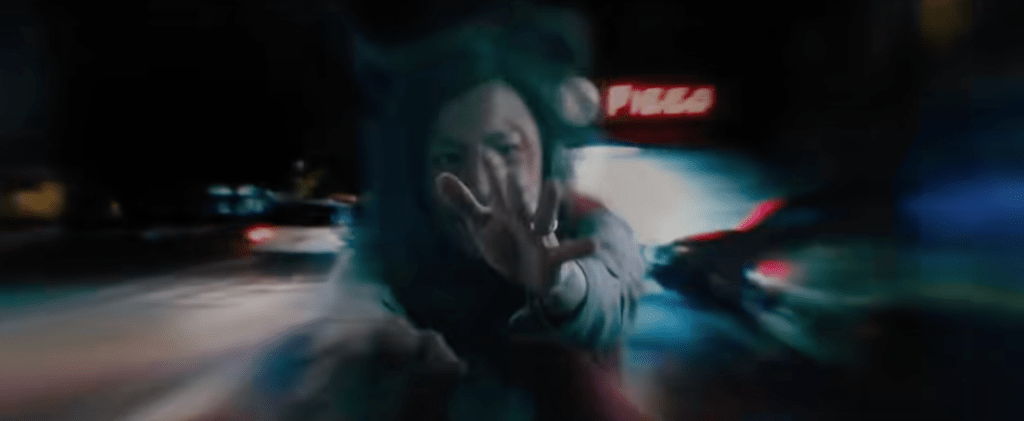
The film builds a unique post-cinematic aesthetic by bringing together elements of multiple film styles and genres. The film has the futuristic sense and special effects of science fiction films, the action design of Wuxia films, the emotional tension of family dramas, and the expression of absurd comedy and surrealism. This mix of styles reflects the cross-border quality of post-film aesthetics: it does not adhere to a single genre, but integrates multiple cultural symbols, art forms and aesthetic expressions.
For example, Evelyn’s experiences in different universes show very different visual styles – some are cool and futuristic with cyberpunk, others are soft and romantic with classic romance movies. This changing aesthetic style not only reflects the infinite possibilities of the multiverse, but also echoes the post-cinematic aesthetic’s tolerance for multicultural and artistic expression.
With its multi-dimensional narration, style fusion and technical innovation, The Whole Universe becomes a typical representative of post-film aesthetics. The film not only shows rich visual possibilities through the multiverse, but also explores the complexity of identity and meaning at the philosophical level, fully embodiments the infinite potential of film art in the post-modern context.
Sean Cubitt, ‘Source Code, Eco Criticism and Subjectivity’, in Vernallis, Herzog and Richardson eds, The Oxford Handbook of Image and Sound in Digital Media, Chapter 28, New York, Oxford: oxford University Press.
Xuping Yue 33814020
 Digital Audiovisual Media Class Blog
Leave a comment