According to Davé states, ‘the proliferation of South Asian American leading roles and characters who are identified as racial minorities and who address their race and ethnic background in the narrative arc of the story appear primarily in comedic genres’ (Davé, 2017). This means that Indian characters are normalised to be there for comedic reasons, which is not the case with some TV shows such as ‘Never Have I Ever’ (2020) and ‘Bridgerton’ (2024) as they positively portray Indian characters and are seen so much more than a comedic character.
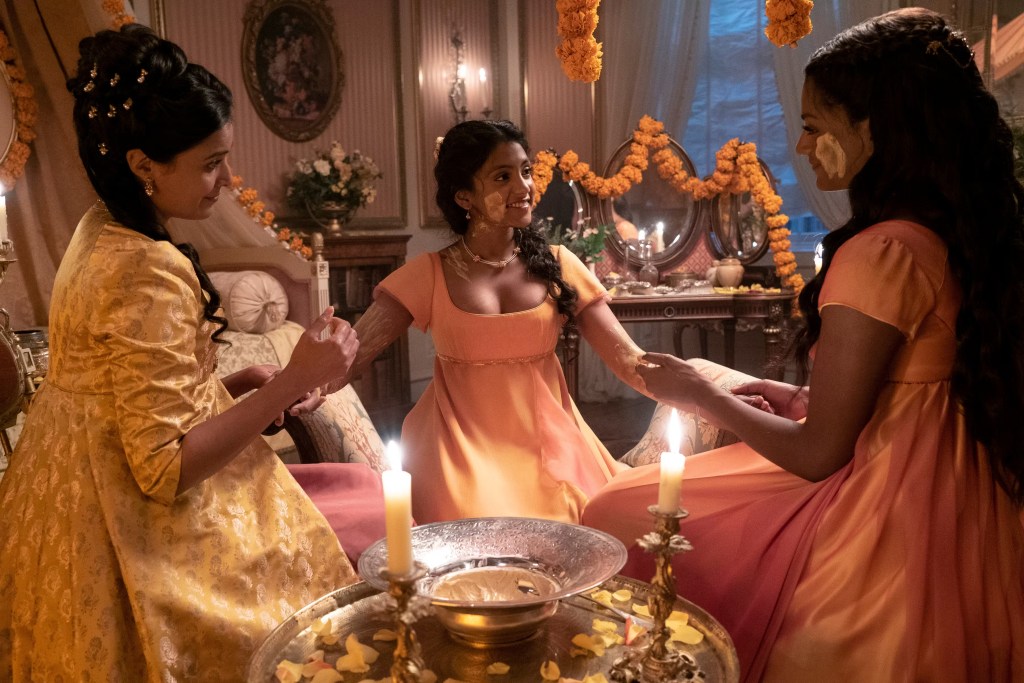
For example, in Bridgerton season 2, episode 6, we see the Sharma women putting turmeric paste on Edwina the night before the wedding, with the non-diegetic sound being a song from a famous Hindi film. This again highlights the positive way of reinforcing the representation of Indian characters, as they are not seen in the way the Hollywood industry would perceive them, such as ‘nerdy’.
Davé further explains Indians and South Asians are often stereotyped or reduced to their accents or the way they speak “brown voices” (Davé, 2017). Yes, the Sharma sisters in the series do have accents to show their ethnicity, but they were just more than accents, with small details like the clothes embroidered with Indian mandalas to Kate Sharma bringing her tea leaves from India.
Furthermore, ‘Never Have I Ever’ (2020) demonstrates my point on representing South Asian communities in a positive light and not for comedic purposes. This series mainly focuses on a Tamil teenage girl who has a normal teenage life with boys and wants to be popular, which is rarely seen in contemporary modern media from the perspective of a South Asian girl. Overall, Netflix shows are becoming more diverse to other ethnic groups with shows like these, and the industry as a whole is moving away from the general racial stereotypes shown in other TV shows.

Bibliography:
Bridgerton. (2024). Netflix.
Davé, S. (2017). Racial Accents, Hollywood Casting, and Asian American Studies. Cinema Journal, 56(3), pp.142–147. doi:https://doi.org/10.1353/cj.2017.0030.
Never Have I Ever. (2020). Netflix.
Dhruvi Dhokia
 Digital Audiovisual Media Class Blog
Leave a comment