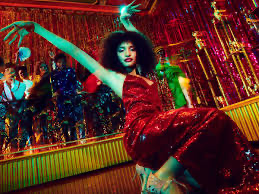
‘Pose’ is a groundbreaking television series that can be analysed through various theoretical frameworks discussed in the articles cited. The show, which focuses on the African-American and Latino LGBTQ ballroom culture scene in New York City in the late 1980s, can be analysed in relation to the concepts of Trans TV and queer television.
In Michael Goddard and Christopher Hogg’s articles on Trans TV, the show ‘Pose’ can be seen as a significant intervention into contemporary television by centering the stories and experiences of trans and non-binary individuals. The show features a diverse cast of LGBTQ characters, including transgender women of colour, who navigate issues of identity, visibility, and community within the ballroom scene. The representation of these characters on screen challenges mainstream media’s traditional portrayals of LGBTQ individuals and offers a more authentic and nuanced depiction of their lives.

Anamarija Horvat’s article on depictions of migration and mobility in LGBTQ television can also be applied to ‘Pose’, as the show explores themes of displacement, belonging, and community within the context of the ballroom scene. Many of the characters in the show are marginalised individuals who have been forced to leave their families and communities due to their gender identity and sexual orientation. The show highlights the importance of creating chosen families and finding acceptance and support within the LGBTQ community.
In Amy Villarejo’s analysis of Jill Soloway’s ‘Transparent’, the concept of revolutionary storytelling in queer television can also be applied to ‘Pose’. The show challenges traditional narratives and representation of LGBTQ individuals by centering the experiences of transgender women of colour and highlighting the resilience and creativity of the ballroom scene. In addition, the show was written and directed by a trans women of colour (Janet Mock), furthering the idea of retelling marginalised communities stories by individuals that actually belong to those communities.
The properties of emerging televisual platforms have revolutionised the landscape of representation. Streaming services, in particular, have disrupted the conventional broadcast model by offering a more diverse and global audience base. This shift has empowered creators to delve into a broader spectrum of narratives, perspectives, and characters that might have struggled to find a foothold in traditional television. The on-demand nature of these platforms has catalysed experimentation in storytelling, fostering the emergence of unconventional and varied representations.
Naomi Senior – 3374010801
Pose: Season 1 (Netflix 2018) Dir. Janet Mock
Michael Goddard and Christopher Hogg (2018), ‘Introduction: Trans TV as concept and intervention into contemporary television’, Critical Studies in Television 13:4: https://journals.sagepub.com/doi/full/10.1177/1749602018798217
Michael Goddard and Chris Hogg 2020, ‘Introduction: Trans TV Re-evaluated part II’, Trans TV Dossier 3, Critical Studies In Television 15: 3: https://journals.sagepub.com/toc/csta/15/3
Anamarija Horvat ‘Crossing the Borders of Queer TV: Depictions of migration and (im)mobility in contemporary LGBTQ television’, Trans TV Dossier 3, Critical Studies In Television 15: 3: https://journals.sagepub.com/toc/csta/15/3 Amy Villarejo, ‘Jewish, Queerish, Trans and Completely Revolutionary: Jill [sic] Soloway’s Transparent and the New Television. Film Quarterly 69:4.
 Digital Audiovisual Media Class Blog
Leave a comment