Written by: Liah Twumasi Danquah | 33772944
Everything Everywhere All at Once, (2022) is a wild cinematic ride that lives up to its overwhelming title. The film is a fragmented depiction of nihilism, the belief that life is meaningless, illustrating how individuals may feel when their world seems to have “collapsed into an emotional void” (Krishnamurthy, et al, 2024, pp.69). By rejecting traditional editing rules and embracing the chaotic themes and style, the film embodies Steven Shaviro’s concept of post-continuity – where “there is no sense of spatiotemporal continuity” and the viewers are hit with a “series of shocks” (Shaviro, 2016, p.51).This approach doesn’t just mirror the complexity of modern life, it reveals something more relatable: the feeling of chaos we may all face in our own lifes.
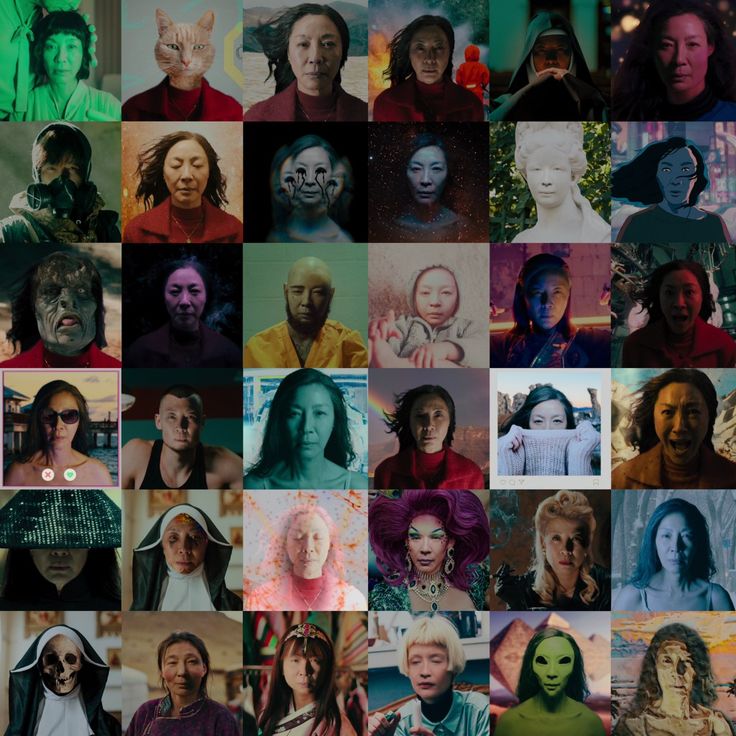
Post-continuity, as Shaviro describes, focuses on spectacle and sensory impact over traditional structures to narrative and storytelling. A great example from the film is the montage where Everlyn, the protagonist, rapidly flashes through countless dimensions. Each dimension brings a mix of colours, moods, effects and timelines which forces the audience into an array of unique audiovisual experiences. This could mimic what it might feel like to be omnipresent – a concept in post-cinema that arguably makes it more exhilarating. This aligns with Matthais Stork’s critique of “chaos cinema” where scenes become like a “never ending crescendo of flair and spectacle” (Stork, 2011). Yet, unlike Stork who sees the chaos in a more negative light, this chaos serves a purpose: it conveys the vastness of the multiverse while showing the emotional weight behind Everlyn’s choices. That is to say the film demonstrates how postcontinuity can go beyond just chaos to evoke a deeper emotional resonance.
Rather than using fragmentation for spectacle alone or seeing chaos in a negative light, Everything Everywhere All at Once meaningfully illustrates its chaos in character and emotion. It transforms chaos into a powerful tool for storytelling and connection.
References
Shaviro, S. (2016). Post-continuity: an introduction.
Shaviro, S. (2010) ‘Post-Cinematic Affect: On Grace Jones, Boarding Gate and Southland Tales’, Film-philosophy, 14(1), pp. 1–102. Available at: https://doi.org/10.3366/film.2010.0001.
Bailey, John. (5 Dec, 2011.) “Matthias Stork: Chaos Cinema/Classical Cinema, Part 3.” John’s Bailiwick. Web. <http://www.theasc.com/blog/2011/12/05/ matthais-stork-chaos-cinemaclassical-cinema-part-three/>.
Krishnamurthy, S., Bhardwaj, A., Kumar, M., Dhruve, N. and Gopal, S., 2024. Everything, everywhere, all at once: A cinematic journey exploring mental health themes: From existentialism to nihilism and everything in between. Journal of Psychiatry Spectrum, 3(1), pp.68-68.
 Digital Audiovisual Media Class Blog
Leave a comment