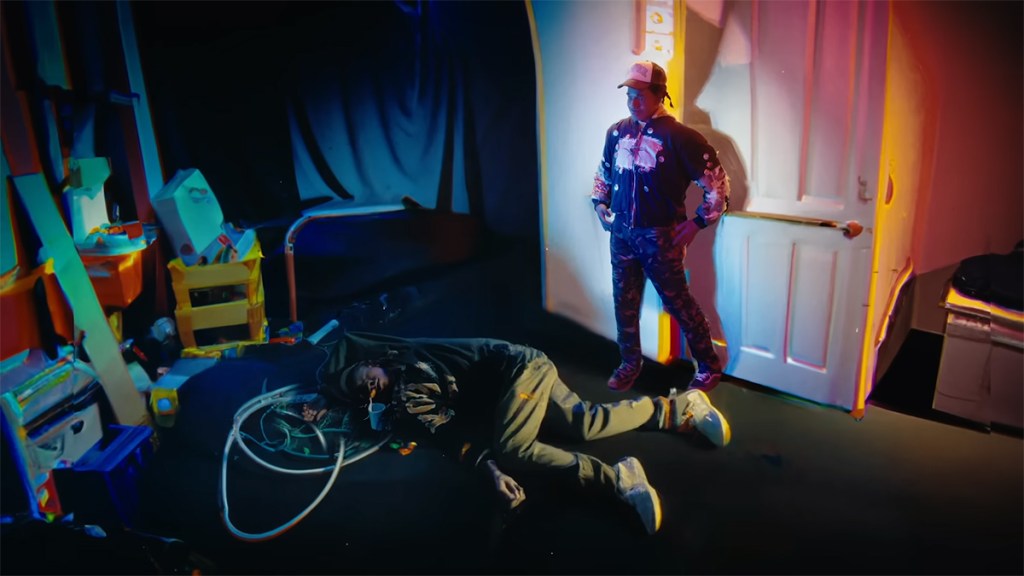
Known for his use of glitch aesthetics, strange visual narrative, and post-production wizardry, Dan Streit has become a defining character in the scene of modern music videos. His ability to combine intentional distortion with emotionally engaging stories not only enriches his works with musicians like Joji, Asap Rocky and Charli XCX but also establishes him as a visionary in modern digital artistry.
Streit’s works frequently feature repeated symbols, warped images, and fractured tales with lots of interpretation left to be done. In Joji’s “Glimpse of Us,” for example, a mysterious, unfinished square with a dot shows up often – a symbol Streit refuses to explain precisely in his interview to Billboard (2023). This choice captures his larger creative philosophy: letting viewers put their own perceptions onto his work instead of providing its meaning.

His glitch aesthetic is illustrated in this embrace of uncertainty. From pixelated frames to warped transitions, the deliberate “errors”, his videos represent imperfection, emotional division, or the fractured way we see the world.
Streit’s directing approach is much shaped by his expertise as an editor. To make his work “fun, engaging, and re-watchable,” he says he combines visual approaches like 3D animation and distorted VFX (visual effects), (Runway). His experience in editing helps him not only to approach a scene but also to visualise the final product during filming. Knowing how things might subsequently be changed in post-production, this understanding helps him to be flexible enough to respond to unplanned events.
Streit transforms everyday film into something remarkable by stacking mistakes and effects, producing images that alternate between anarchy and harmony.
Streit uses VFX and distortion not for spectacle’s own sake but rather to create immersive, bizarre worlds. His videos regularly blur the border between the real and the imagined, whether they use computer faults to replicate dreamy experiences or 3D animation. Shaviro’s analysis of “glitch aesthetics” identifies a jittery, looping visual rhythm as central to this style. This method can be seen in Dan Streit’s video for A$AP Rocky’s “Shi**in’ Me,” where he contrasts distorted visuals, neon colours, and fast pace shots (0:35–0:45) with more conventional forms like VHS and black-and-white CCTV-style footage (1:26). The end effect is a chaotic but captivating visual framework that reflects the diverse and eccentric aesthetic of the song itself, therefore accentuating its energy and attitude. Perfectly complimenting the tone of the music, this dynamic visual experience produced by the interaction of distortion and tradition seems both cutting edge and nostalgic.
Fundamentally, Streit’s glitch style is a statement on the flawed, fractured character of the digital age. His paintings frequently show themes of alienation, separation, and the conflict between the natural and the artificial.
Post By: Elizaveta Vorobyeva 33768066
Bibliography:
Steven Shaviro, (2017), ‘Glitch Aesthetics’, Digital Music Video:
Runway customers: Distorting reality with Dan Streit. Runway. (n.d.). https://runwayml.com/customers/distorting-reality-with-dan-streit
Scarano, R. (2023, February 7). “Do you have any footage from something crazy?”: How director Dan Streit made Joji’s chaotic “glimpse of us” video. Billboard. https://www.billboard.com/music/pop/joji-glimpse-of-us-video-director-interview-1235107619/
 Digital Audiovisual Media Class Blog
Leave a comment