editor LAI WEI 33870474
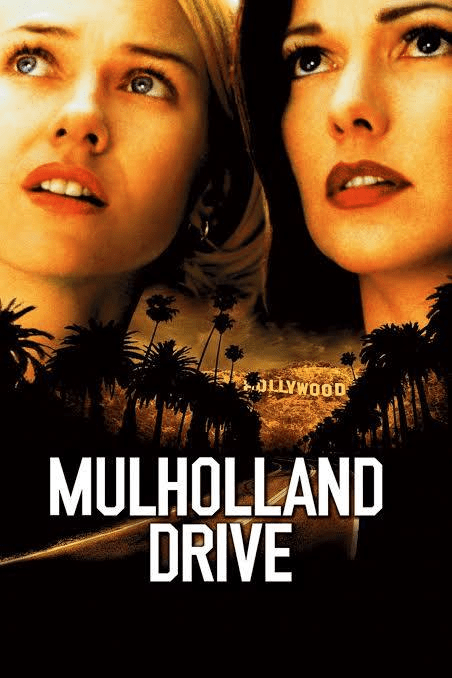
David Lynch’s 2001 psychological drama Mulholland Drive weaves an erotic tale of mystery, deceit and fear of the unknown. The director himself claimed that the inspiration for Mulholland Drive came from a meditation that flooded his mind with images and ideas in a matter of minutes (Lynch). This “neo-noir humor” film with its themes of self-consciousness and false reality is clearly a work of postmodernist cinema.

The most common theory is that the first half is the dream, the second the reality. Diane yearns for a better life, and the first half is her fantasy – where she’s full of hope for the future and with the love of her life. In the second, we see her real existence, full of pain and suffering.
The theory of altered states as a postmodernist film tool is described as “Time travel that provides another way to shape reality and play ‘what if’ games with society” (Graduate School Networked Researcher). While Mulholland Drive is not a film that focuses on literal time travel (jumping between centuries and time periods), the film continually skips time frames from past to present. The use of flashbacks are a key storytelling tool Lynch uses to explain character relationships in both reality and fantasy, so much so that it is often difficult to distinguish past from present or reality from hyper-reality (D’Ocarmo). Because it’s only halfway through the entire movie that we find the young the character, aspiring Betty is only a fantasy of an actual jaded Hollywood actress named Diane- Mulholland Drive quite literally plays the “what if” game with Diane’s world. Every aspect of Diane’s life including surrounding objects and people are mirrored in her alternate reality of “what if”. Diane has created a more desirable fantasy for herself, and chooses to live through her hyper-reality alter-ego.
This elaborate fantasy, which accounts for more than one half of the movie, is also an example of the postmodernist theory of hyper-reality. While Diane’s hyper-reality is not a “technological created reality” as described by the founder of the theory Jean Baudrillard, is it still an extension of Diane’s identity conjured up as an escape from her actual life (Graduate School Networked Researcher).
When a film uses the postmodernist tactic of “altered states”, it explores an internal reality through the eyes of an individual whose point of view is altered by mental illness or substances (drugs, alcohol etc) (Graduate School Networked Researcher). This often causes certain uneasiness to the film and a convoluted progression to the storyline. Lines between reality and fantasy are blurred, images are warped and the concept of time is disfigured (D’Orcamo). In Mulholland Drive Diane, plagued with guilt and jealousy, begins to experience a mental breakdown in which she both fantasizes about an imaginary lover and hallucinates grotesque images of fear and violence. This mental instability makes it difficult for the audience to distinguish what is real and what is imaginary (Stewart). It is up to the audience to question how much of the plot is real and how much is confabulated by Diane’s warped nightmares.
Director David Lynch, a filmmaker with an art history education, uses a postmodernist style to convey an extremely complicated storyline with an artistic flair and dark undertone (Lynch). Using hyper-realities, altered states of mind and time-bending storylines- Mulholland Drive is an essential film in the study of postmodernism art.
Reference:
Post Modern Film explained by David Lynch’s Mulholland Drivehttps://journalabsurdo.wordpress.com/2014/05/14/post-modern-film-explained-by-david-lynchs-mulholland-drive/
 Digital Audiovisual Media Class Blog
Leave a comment