Music video is an important part of social popular culture. They are not only a form of artistic expression, but also an important carrier for exploring social issues such as race, gender, sexuality, etc. Taylor Swift, as one of the world’s top female singers, directly focuses on the social issues of male privilege and gender inequality through her music work “The Man”, fighting back against the gender double standard phenomenon in society.
Music video for “The Man”
In the video, we can see Taylor playing a typical “successful male figure”, showing the privileges that men enjoy in society through multiple scenarios and exaggerated “male characteristics”. For example: men who take care of babies are considered the best fathers in the world, men are more likely to be promoted in the workplace, indecent sitting postures on the subway, and social views on the marriage age of men and women.
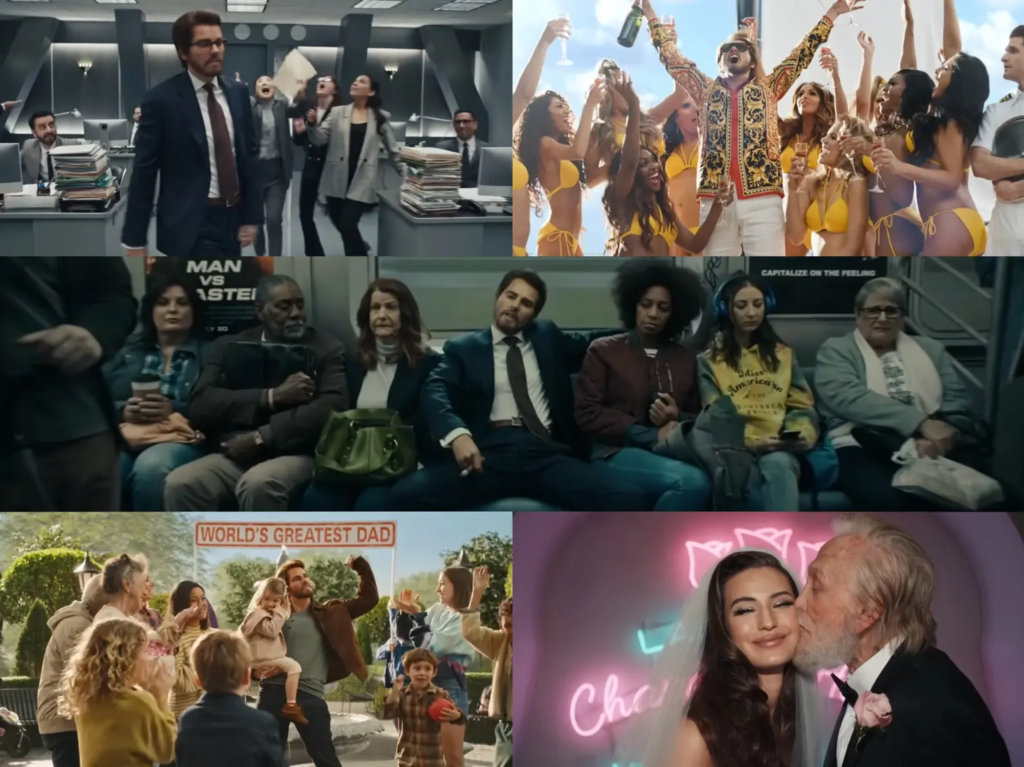
Several shots of “The Man”
As Railton and Watson pointed out, ‘consider the relationship between music video and cultural identity as a litany of imposed subjectivities – but rather as a dialogic encounter between different identity positions’ (2011), this dialogic nature is particularly prominent in Taylor’s music video “The Man”. Through the exaggerated performance of male privilege, the contradiction between male and female gender identities is directly exposed, further emphasizing the promotion and reflection of gender equality.
In addition, from the perspective of digital aesthetics, The Man uses a multi-scene, non-linear narrative method, which fully reflects the “Mixing Board Aesthetic” mentioned by Carol Vernallis. She claims that after is initial flowering in the 1980s, music video has entered a new aesthetic era, characterized by new digital technologies, new kinds of cross media authorship (Vernallis, 2013, p.5-6).
In short, as a music video, The Man reflects a strong appeal for gender inequality. At the same time, through the innovation of digital technology and narrative, Taylor cleverly integrates social criticism into popular culture videos.
References:
Railton, D. and Watson, P. (2011) ‘Music video in black and white: Race and femininity’. In: Music Video and the Politics of Representation. London: Edinburgh University Press, pp. 87-107.
Vernallis, Carol, Unruly Media: YouTube, Music Video, and the New Digital Cinema (2013; online edn, Oxford Academic, 26 Sept. 2013), https://doi.org/10.1093/acprof:oso/9780199766994.001.0001, accessed 29 Nov. 2024.
By Yixuan Wu 33694168
 Digital Audiovisual Media Class Blog
Leave a comment