The rise of streaming platforms has revolutionized viewers’ viewing behavior and content consumption patterns. As Lotz claims that while traditional television relies on linear schedules to fix viewers’ viewing habits, the Internet-Distributed Television model redefines the rules of television content distribution by giving viewers “the ability to control viewing” (Lotz, 2014, p. 54). The Internet-Distributed Television model redefines the rules of television content distribution by giving viewers “the ability to control viewing” (Lotz, 2014, p. 54). This model allows viewers to choose when and how long to watch content at their own pace and preference, thus providing the basis for Netflix’s Binge-viewing phenomenon.

A screenshot of Netflix’s homepage, where the platform recommends shows based on user preferences.
Netflix’s “full-season release” strategy is one of the core driving forces behind this phenomenon. According to Netflix and the Re-Invention of Television, Mareike Jenner claims that “Crucially, Netflix has also abandoned the idea of the linear television schedule: Netflix puts all episodes of one series online at once, resembling more models of book, or, more accurately, DVD publishing” (Lotz 2014, 2017 cited in Jenner, 2023).This means that viewers no longer have to follow the fixed broadcast schedule of traditional TV, but can decide when and for how long to watch content at their own pace and preference, and Netflix’s “any device, anywhere” strategy further enhances this flexibility, making it an important technological foundation for Binge-viewing.
At the same time, Netflix further guides users to continue watching through interface settings, such as the “Next Episode” countdown button logo that appears on the page after each episode, naturally leading users to the next episode. This strategy, as Kevin McDonald and Daniel Smith-Rowsey note in The Netflix Effect, is an intentional viewer engagement mechanism designed to extend the length of viewing (McDonald and Smith-Rowsey, 2016).
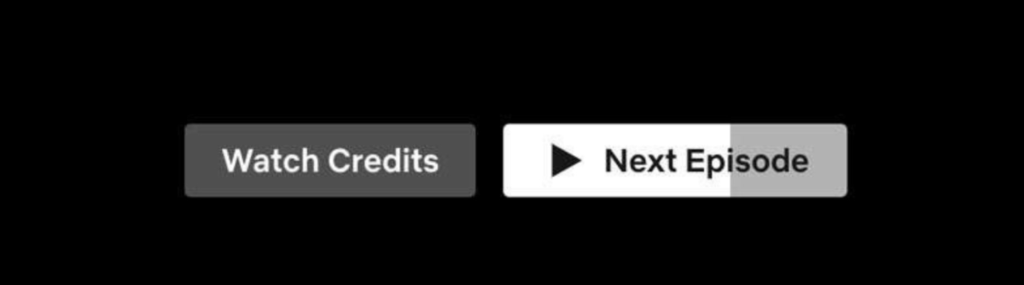
Netflix offers viewers the option to continue after an episode has finished.
Overall, the Binge-viewing reflects the profound impact of streaming technology on consumer culture. Facing a massive amounts of content, viewers have shifted from traditional “passive acceptance” to “active choice”. And streaming platforms, led by Netflix, have provided this support, and further facilitated continue watching through technology.
References:
Lotz, A.D. (2014) The Television Will Be Revolutionized. 2nd edn. New York: NYU Press.
Lotz, A.D. (2017) Portals: A Treatise on Internet-Distributed Television. Ann Arbor, MI: Maize Books, an imprint of Michigan Publishing.
Jenner, M. (2023) Netflix and the Re-Invention of Television. Cham: Palgrave Macmillan.
McDonald, K. and Smith-Rowsey, D. (eds) (2016) The Netflix Effect: Technology and Entertainment in the 21st Century. London: Bloomsbury Academic.
By Yixuan Wu 33694168
 Digital Audiovisual Media Class Blog
Leave a comment