Brown explores how digital technology redefines “space” in cinema by building a virtual world, allowing viewers to experience a sense of space beyond reality. This shifts cinema from being merely recording to creative (2013). Bukatman also thinks that special effects serve as a medium for exploring the limits of human perception. By challenging viewers’ understanding of physical reality, these effects can provoke philosophical reflection (2003).
Interstellar is a science fiction film that won Best Visual Effects at the 87th Academy Awards. I was impressed by its stunning visual effects, which significantly disrupt traditional perceptions and understanding of space through the use of digital technology, offering a kaleidoscopic sensory experience.
One of the most astonishing shots is the scene where the 5D space represented by a 3D scene in the film. The protagonist is transported to a space called the Tesseract, where he can perceive five dimensions instead of four. This enables him to observe every moment of the past, present, and future, and even influence gravity at any point in time. This kaleidoscopic imagery not only visualizes the unimaginable concept of higher dimensions but also evokes a profound sense of insignificance and fragmentation in viewers.

Three dimensional representation of five dimensional space
Moreover, the depiction of the black hole in this film is also amazing. Beyond the visual spectacle of the cosmic phenomenon, its scientific accuracy provides an intellectual and cognitive impact. The creation of the black hole rigorously obeys physical rules, demonstrating that digital technology can not only be creative but even predictive.

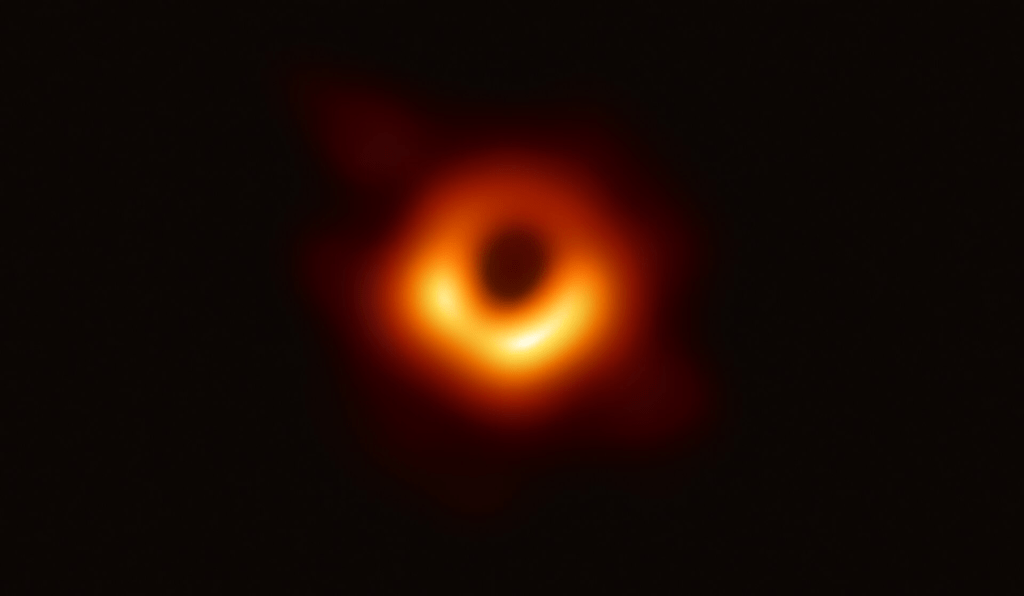
The left is the black hole in Interstellar and the right is the first image of a black hole (EHT, 2019)
Michio Kaku, a theoretical physicist at City College of New York, told CBS News that the film “could set the gold standard for science-fiction movies for years to come.”
Digital technology predicts and visualizes scenes that are otherwise impossible to witness in reality or even imagine, making it a tool with practical significance for exploring people’s boundaries of perception and cognition, rather than merely a showcase of visual spectacle.
References:
Brown, W. (2013) ‘Digital Cinema’s Conquest of Space’. In: SuperCinema: Film-Philosophy for the Digital Age. Oxford: Berghahn.
Bukatman, S. (2003) ‘The Ultimate Trip: Special Effects and Kaleidoscopic Perception’. In: Matters of Gravity: Special Effects and Supermen in the 20th Century. Durham, NC: Duke University Press.
Bernstein, M.F. (2016) ‘A Physicist in Hollywood’. Princeton Alumni Weekly [online]. Available at: https://paw.princeton.edu/article/physicist-hollywood (Accessed: 29 November 2024).
EHT (2019) ‘First Image of a Black Hole’. ESO [online]. Available at: https://www.eso.org/public/images/eso1907a/ (Accessed: 29 November 2024).
By Yixuan Wu 33694168
 Digital Audiovisual Media Class Blog
Leave a comment