Shaviro’s “post-cinematic affect” emphasizes that films engage viewers not only through logical understanding but also by evoking instinctive and emotional experiences (Shaviro, 2010). Emotion is no longer additional to a film’s narrative but has become a “non-verbal expression” delivered through visual style and technological innovation.
The first related film that comes to my mind is Everything Everywhere All at Once, which I think is a typical example. Michelle Yeoh acts as a Chinese-American immigrant undergoing a tax audit, and she finds that she must connect with other versions of herself across parallel universes to prevent the multiverse from destroying. In this film, fancy visual effects and rapid scenario editing are used to draw the viewers into a chaotic and kaleidoscopic emotional storm.
A. O. Scott from The New York Times describes the film as a “swirl of genre anarchy,” stating, “While the hectic action sequences and flights of science-fiction mumbo-jumbo are a big part of the fun (and the marketing), they aren’t really the point. a bittersweet domestic drama, a marital comedy, a story of immigrant striving, and a hurt-filled ballad of mother-daughter love” (2022).
This film breaks traditional linear storytelling through its rapid transitions between universes, forcing viewers to experience fragmented narratives and chaotic scenarios. Rather than following logic or causation, its storytelling directly engages emotions and sensations, immersing viewers in the characters’ confusion and struggles—especially through the deconstruction and reconstruction of familial relationships. Emily St. James also calls the film a growing subgenre of “millennial parental apology fantasy,” creating a world where parents and children reconcile (2022).
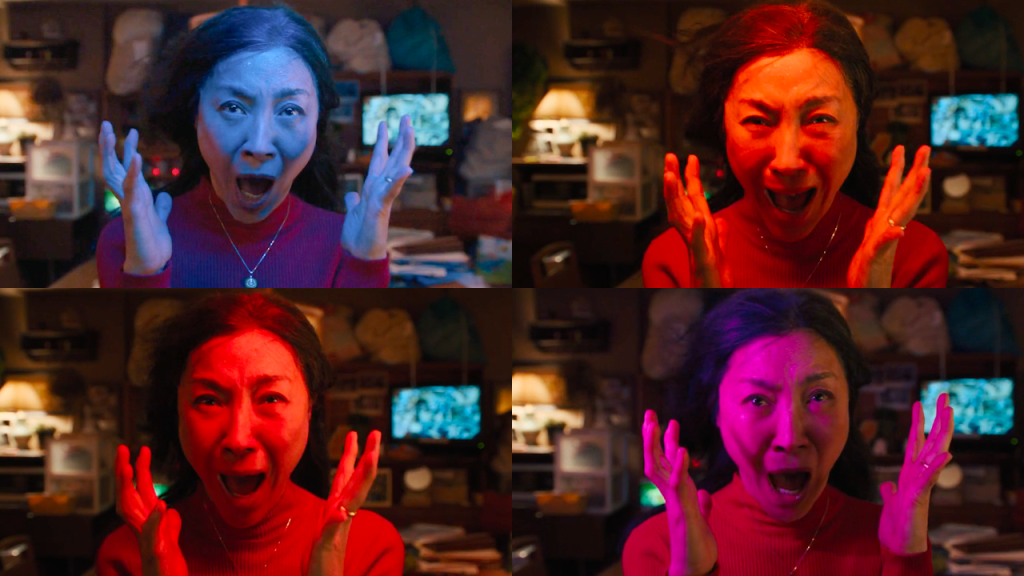
Several shots imitating Munch’s The Scream
The film also focuses on the exploration of Chinese American female identity. De Beauvoir thinks: “He is the Subject; he is the Absolute. She is the Other.” (1949, p.26) In the film, protagonist’s living condition and conflicts dramatically represent the “otherness” dilemma and loss of self faced by most contemporary Chinese women. This film also resonates with the anxieties of postmodern life, such as the protagonist’s family’s tax issues, which indicates the alienation and anxiety of ordinary individuals in capitalist globalization.

References:
Shaviro, S. (2010). Post-Cinematic Affect: On Grace Jones, Boarding Gate and Southland Tales. Film-Philosophy, 14(1), pp.1–102. doi:https://doi.org/10.3366/film.2010.0001.
Scott, A.O. (2022). ‘Everything Everywhere All at Once’ Review: It’s Messy, and Glorious. [online] Nytimes.com. Available at: https://www.nytimes.com/2022/03/24/movies/everything-everywhere-all-at-once-review.html [Accessed 24 Nov. 2024].
James, E.S. (2022). Hollywood’s hot new trend: Parents who say they’re sorry. [online] Vox. Available at: https://www.vox.com/culture/23025832/everything-everywhere-all-at-once-parental-apology-fantasy-turning-red-oscars [Accessed 24 Nov. 2024].
De Beauvoir, S. (1949). The Second Sex. [online] Vintage Books. Available at: https://uberty.org/wp-content/uploads/2015/09/1949_simone-de-beauvoir-the-second-sex.pdf.
By Yixuan Wu 33694168
 Digital Audiovisual Media Class Blog
Leave a comment