Steven Shaviro introduces the concept of ‘post-cinematic affect’ (2010) to describe how films have evolved in the neoliberal, capitalist 21st century. Drawing on Massumi’s distinction between affect and emotion, Shaviro explains that affect is something that overwhelms us, while emotion is a structured, understandable response: ‘Emotion is affect captured by a subject’ (2010: p3). He likens this process of capturing affect to the harnessing of labor power for profit (2010: p6).
Shaviro argues that contemporary films use increasingly abstract techniques to express the experience of life under capitalism, where everything revolves around commodification. This relentless self-commodification leads to a dehumanized, fragmented sense of self (2010: p22) .As a result, many post-cinematic films no longer rely on realism, as our disorienting reality can only be effectively captured through abstraction and experimental techniques (Shaviro, 2010: p35). With increasingly sophisticated technology at their disposal, filmmakers show us not what reality is, but what it feels like (Shaviro, 2010: p2).
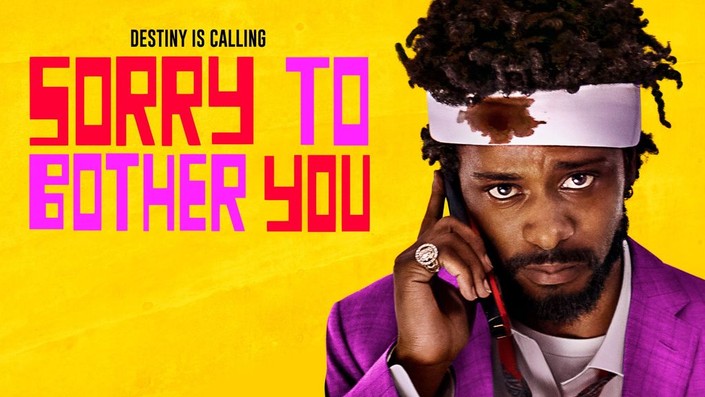
One striking example of this is Boots Riley’s Sorry to Bother You (2018). The film follows Cash, a young Black man in America who takes a job at a call center. He quickly discovers that using a ‘white voice’ makes him more successful at sales, forcing him to adopt this persona to appear more palatable. This begins to affect his sense of self, with moments where he unintentionally slips into his ‘white voice’. The film uses a white actor to do the voice-over for these parts and we see Cash talking in a voice that doesn’t sound like him at all. This absurd device represents how Cash must conform to whiteness, fragmenting his identity to navigate a white supremacist society.
In another surreal twist, a wealthy businessman transforms his workers into horse-human hybrids to increase their strength and productivity. This grotesque metaphor underscores the commodification and dehumanization inherent in capitalism, particularly its exploitation of marginalized communities, including people of color.
Therefore, through its abstract storytelling and surreal imagery, Sorry to Bother You exemplifies post-cinematic affect, using inventive techniques to convey the fragmented, alienating experience of living as a marginalized person in a capitalist world.
Written by Maisie Kelly 33752521
Bibliography
Shaviro, S. (2010) ‘Post-Cinematic Affect: On Grace Jones, Boarding Gate and Southland Tales’, Film Philosophy. 14(1), pp 1-102.
Filmography
Sorry to Bother You (2018) Directed by B. Riley [Feature film]. Annapurna Pictures: United States.
 Digital Audiovisual Media Class Blog
Leave a comment