The series of Love, Death & Robots show many characters who break stereotypes through diverse stories, fully reflecting the progress of gender concepts. For example, in the episode ‘Sonnie’s Edge’, even in just twenty minutes, Sunny’s unique personality charm is vividly portrayed. From the appearance, Sonnie doesn’t look like the familiar female characters. She has scars on her face, short hair, and fierce eyes. Moreover, she can control a fierce beast, creating a strong contrast.

In many science fiction works, women are often depicted as vulnerable groups, relying on male characters, or playing rescued roles in the plot. However, Sonnie’s image completely overturned this setting. At the beginning of the story, the battle between Sonnie and the monster shows her decision-making and control abilities. In her, we see the power of revenge presented through a female perspective, and this power does not rely on the salvation of male characters, but through her own endurance and transformation of pain. Through the plot, we can understand that Sonnie’s revenge is not only for past traumas, but also her resistance to oppression and violence against women in the outside world.
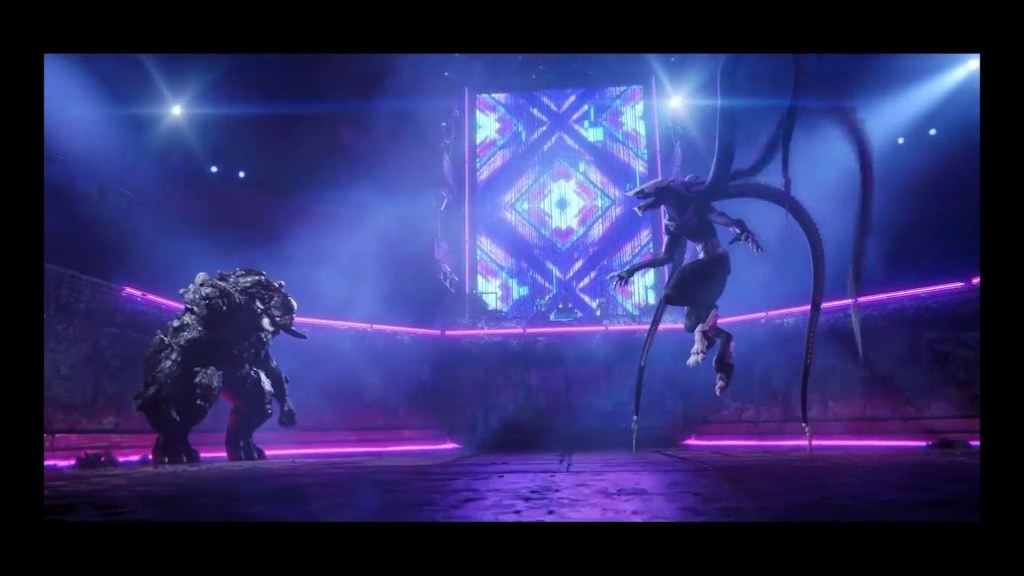
Moreover, the sexual orientation of the characters in the series is no longer limited to heterosexuality, and is not the main focus of the story. Instead, it is naturally integrated into the characters’ identities. Sonnie’s sexual orientation includes women, which led her to fall into the trap of the other party. However, she seems to have anticipated this and successfully completed her revenge. In addition, the spiritual connection with monsters is also an implicit expression of her emotions. Sonnie’s response to her emotional trauma and how she seeks self revenge and self-identity by controlling these emotions.
In summary, ‘Sonnie’s Edge’ is not just a short film about violence and revenge, but also a wonderful image portrayal. In this future world full of violence and revenge, Sonnie’s existence is not only a display of women’s power, but also a profound reform and reflection on gender, emotions, and power.
By Xin Lin 33740092
References:
Tischler, B. L. (2006). Reel diversity: A social constructionist analysis of race and gender in popular television. The University of Chicago Press.
Gray, H., & Lotz, A. D. (2019). Television studies. Wiley-Blackwell.
 Digital Audiovisual Media Class Blog
Leave a comment