Steven Shaviro put forward the concept of “post-film” in his book Post-Film: The Future of Film and Perception, which focuses on the deconstruction and reshaping of traditional narrative methods, lens language and temporal and spatial structures in contemporary films. This shift affects the emotional experience and perceptual structure of the audience, making the film a multi-dimensional experience rather than just a linear presentation of a story.
Mulholland can be regarded as a representative of the changes in film after the concept of post-film was put forward.
After abandoning the traditional linear narrative, the plot is constructed through fragmented stories and blurred boundaries between dream and reality. This kind of storytelling makes the audience no longer just a passive recipient of information, but an active participant in emotions and perceptions.
In addition, the lens language in Mulholland Drive often uses extremely delicate compositions and color contrasts, as well as manipulation of light, to create a dreamlike atmosphere. The music and sound effects in the film also have a high emotional tension, often through the abrupt switch between sound and music to enhance the emotional feelings of the film, which greatly strengthens the audiovisual experience of the audience.
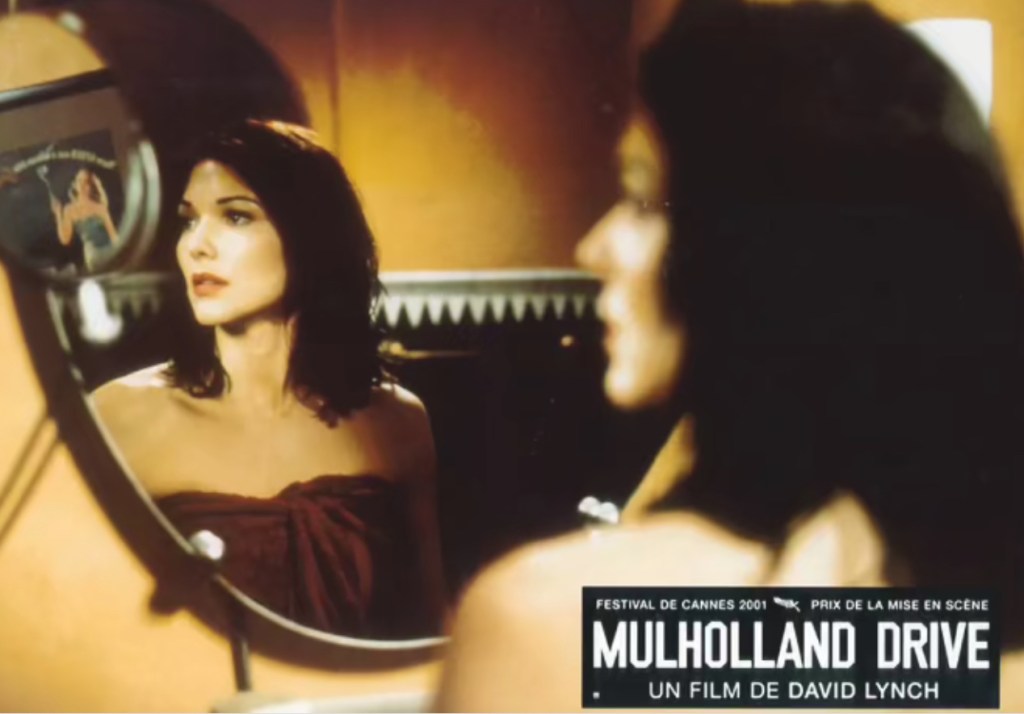

What is more rare is that the characters and plots in the film seem to connect with the subconscious of the audience invisibly, making people feel confused and full of emotional resonance when watching. For Mulholland Drive, the audience’s emotional experience becomes extremely personal, and each person’s understanding and interpretation may be different, but the emotional touch is universal. Therefore, in the post-movie era, the relationship between emotion and perception is no longer one-way, but dynamically interactive.
In this sense, film is no longer just a straight-line story, but a sensory and emotional experience in which the viewer is not only an observer, but also a co-creator of emotion and meaning. This change affects the audience’s perception of the film, and also changes the interactive relationship between emotion and film, making film a more multidimensional, personal and sensory art form. The emotion in the film is closely intertwined with the relationship between image, sound and time, forming a highly personalized and immersive experience.
By Xin Lin
33740092
References
Shaviro, S. (2010). Post-cinema: The future of film perception. Zero Books.
Crowley, J. (2007). Reflections on identity and dream logic in David Lynch’s Mulholland Drive. Film-Philosophy, 11(1), 87-102.
Schofield, M. (2016). After film: The impact of post-cinema on film theory. In A. V. Prozorov (Ed.), Posthumanism and the filmic imagination. Springer.
 Digital Audiovisual Media Class Blog
Leave a comment