By: Lai Wei 33870474
We have all been there. You sit down for a “quick” 45-minute episode to unwind after work. Three hours later, you are deep in a rabbit hole, bleary-eyed, as the “Next Episode” countdown circle spins on the screen.
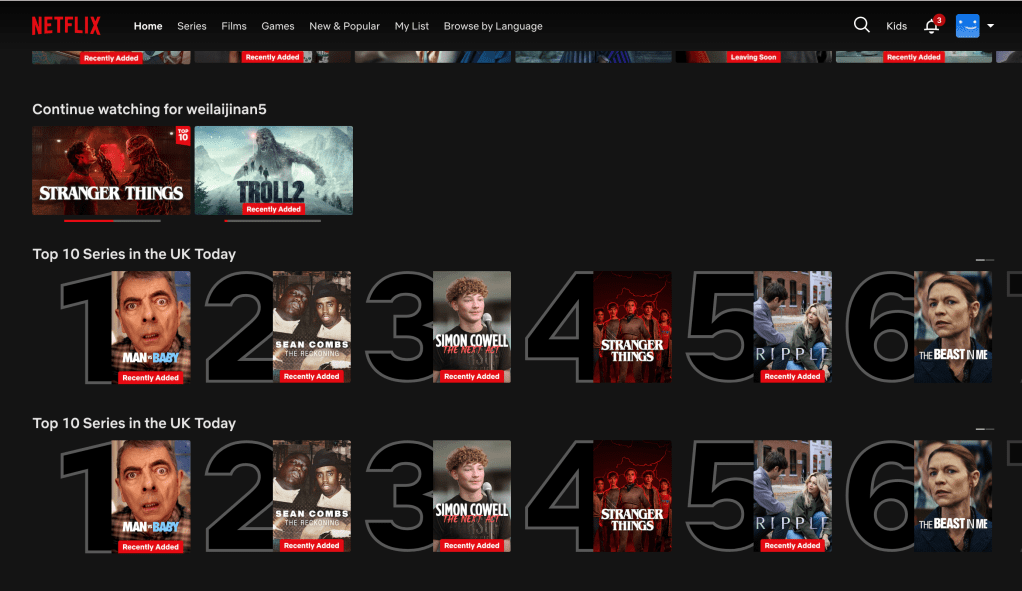
It feels like a guilty pleasure, but from a media studies perspective, this behavior is the result of a massive structural shift. We are no longer watching “television” in the traditional sense; we are navigating what Amanda Lotz (2017) calls “Internet-distributed television.” This week, I’ve been thinking about how this shift from a scheduled broadcast to a digital “portal” changes not just how we watch, but the actual DNA of the stories we are told.
1. The Death of the “Time Slot”: A Global Stage
Remember when you had to be on the couch at 8:00 PM to catch a show? That was the era of “linear TV.” Broadcasters had to program shows that appealed to the widest possible demographic in a specific country to sell ad space.
Netflix broke this model. Because they don’t rely on advertisers or time slots, they can distribute content that linear TV would consider too risky. The prime example is ‘ Squid Game ’. Before the streaming era, a Korean-language survival drama criticizing capitalism would likely have been stuck in a niche art-house slot. But on a “portal” like Netflix, it became a global phenomenon.
This validates Lotz’s theory: Internet distribution creates a “nonlinear distinction.” It allows a show to find its audience globally, over time, without the pressure of opening weekend ratings. It turned a local story into a worldwide conversation about debt and desperation.
2. Bingeing on “Messy” Humanity: The Case of Beef
This freedom from the schedule also changes the narrative structure. Mareike Jenner (2018) argues that Netflix created “TVIV,” a new era defined by the “binge.” Because creators know we are watching multiple episodes at once, they can write complex, slow-burning character arcs that don’t need to resolve neatly every 30 minutes.
We see this brilliance in ‘Beef (2023) ’. It isn’t just a comedy or a drama; it’s an existential crisis stretched over ten episodes. The binge format allows the show to dive deep into the specific, messy rage of its Asian-American protagonists, Danny and Amy.
Unlike older TV representations that often pigeonhole Asian characters into “model minority” stereotypes, the streaming model allows for niche specificity. Beef didn’t have to appeal to everyone immediately; it just had to appeal deeply to its specific audience. The result was a raw, human depiction of class anxiety that felt radically different from standard network TV.
3. The 2024 Reality Check: The Algorithm Trap
However, we shouldn’t get too romantic about this “freedom.” While we think we are choosing what to watch, the algorithm is doing the heavy lifting.
A 2024 report by Luminate highlights a concerning trend: as the “streaming wars” cool down, platforms are becoming more risk-averse. The data shows a shift away from risky, experimental originals toward “comfort viewing” and established franchises (Luminate, 2024). The algorithm is designed to keep you subscribed, which often means feeding you more of what you have already seen rather than challenging you with something new.
Conclusion
Netflix has undeniably revolutionized the medium. It smashed the barriers of language with Squid Game and gave us the complex, “unlikable” protagonists of Beef. But as we move forward, the “portal” is starting to look a lot like a walled garden.
The technology gives us the power to access the whole world, but the algorithm prefers to keep us in our comfort zone. So, the next time you log in, maybe ignore the “Top 10” list. Dig a little deeper. You might find a story the algorithm didn’t think you were ready for.
References
Jenner, M. (2018). Netflix and the Reinvention of Television. Cham: Palgrave Macmillan.
Lotz, A. D. (2017). Portals: A Treatise on Internet-Distributed Television. Ann Arbor: Maize Books.
Luminate. (2024). Year-End Film & TV Report: The Economics of Streaming Content. [Online]. Available at: [https://luminatedata.com/reports] (Accessed: 15 December 2025).
Beef (2023) Netflix.
Squid Game (2021) Netflix.
 Digital Audiovisual Media Class Blog
Leave a comment