By G. Nanthinee Shree
Free Guy (2021), directed by Shawn Levy, follows a Non-Player Character (NPC) whose existence is a repetitive loop of bank heists and scripted pleasantries. This routine is shattered by a chance encounter with a mysterious stranger, forcing him to confront the digital truth: he is merely background code in a sprawling virtual playground. When I first watched this film, I was struck by the uncanny sensation of watching a video game over which I had no control. Rightfully so. This is because the audience lacks narrative agency, we effectively subsume Guy’s role as an NPC.
The film serves as an exemplary case for the “diffuse presence” of contemporary cinema (Casetti, 2015). While storytelling remains central to video games, Free Guy pulls this logic into the cinematic frame, presenting a transmedial narrative that collapses the boundary between the “lived” world of the film and its gamified simulation. This promotes a new structure of feeling, as described by Denson and Leyda (2016), where the film addresses its audience specifically through the interface of a game character. When Guy dons the player “goggles”, the filmmaker reveals the user interface, forcing the audience to experience the world through a mediated, multi-screen lens.
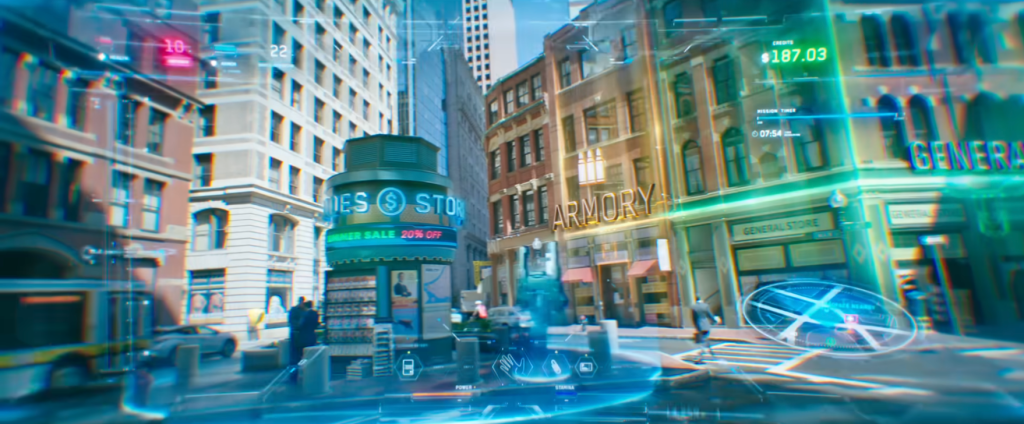
This reiterates a post-cinematic reality where life is perpetually simulated by devices. Much like Steven Shaviro’s (2010) analysis of Demonlover, Free Guy’s transmedial nature ensures that every space contains another within it, only to be contained by yet another. This illustrates Gilles Deleuze’s concept of “open boxes”. Furthermore, it exemplifies the post-cinematic tendency for all audiovisual media to become game-like, reimagining life itself as a competitive sport. Within this multi-media ecology, individuals are defined strictly by their role in the game. Guy, as an NPC, initially lacks the agency of the human-controlled characters who navigate the world with independent intent.
Finally, the cameo of Chris Evans, reacting to Guy wielding Captain America’s shield, perfectly illustrates Shaviro (2010)’s point that in our post-cinematic ecology, it is impossible to meaningfully distinguish between reality and its simulations. They are woven into the same fabric. As an exemplary figure of post-cinematic celebrity, Evans circulates endlessly across Marvel blockbusters and talk shows to memes and advertisements. By drawing on the audience’s collective memory of him as Captain America, his appearance functions as a dense node of intensity (Shaviro, 2010). He acts as an anchoring point that conducts the “affective flows” of an audience whose attention is otherwise scattered across a fragmented media landscape.
Ultimately, Free Guy is a definitive post-cinematic work, capturing a world where our experiences are no longer tethered to a single screen, but distributed across an infinite digital web.
Works cited:
Casetti, F. (2015). The Lumière galaxy: Seven key words for the cinema to come. Columbia University Press. http://ebookcentral.proquest.com/lib/ulondon/detail.action?docID=1922316
Denson, S., & Leyda, J. (2016). Perspectives on post-cinema: An introduction. In S. Denson & J. Leyda (Eds.), Post-cinema: Theorizing 21st-century film (pp. 1–19). REFRAME Books.
Levy, S. (Director). (2021). Free Guy [Film]. 20th Century Studios; 21 Laps Entertainment; Maximum Effort; Berlanti Productions.
Shaviro, S. (2010). Post-cinematic affect: On Grace Jones, Boarding Gate and Southland Tales. Film-Philosophy, 14(1), 1–102. https://doi.org/10.3366/film.2010.0001
 Digital Audiovisual Media Class Blog
Leave a comment