by Mina Kang (33847161)
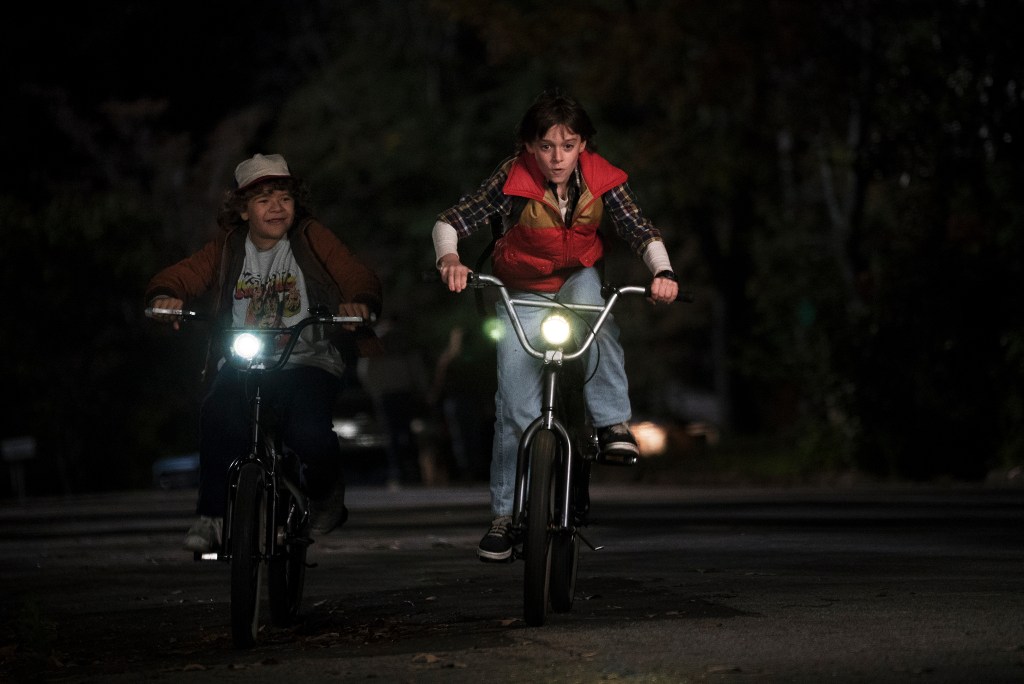
Across its seasons, Stranger Things increasingly shifts from intimate moments of sensory tension to large-scale spectacles of collapse. This progression can be traced from the bicycle sequence in Season 1 to the recent episodes depicting the violent destabilisation of the Upside Down and its intrusion into Hawkins. While these scenes differ drastically in scale, they are united by a post-cinematic logic in which affect, sensation, and perceptual instability take precedence over narrative coherence. Read through the lens of post-cinema and chaos cinema, these moments reveal a consistent strategy for organising viewer experience.
The early bicycle sequence operates through sensory restraint. Darkness dominates the frame, while bicycle headlights fracture space into partial glimpses. Sound replaces dialogue as the primary carrier of tension: wheels scrape the asphalt, breath quickens, and music tightens around the viewer’s pulse. Affect emerges through bodily synchronisation rather than narrative understanding. The scene exemplifies post-cinema’s interest in how moving images modulate perception and attention, particularly within a streaming context where sustained focus cannot be assumed.
In the later seasons, the collapse of the Upside Down represents not a break from this logic, but its amplification. Instead of visual scarcity, the viewer encounters sensory excess. Cracks split the town, gravity falters, bodies levitate, and sound design becomes dense and overwhelming. These sequences align closely with what Steven Shaviro describes as chaos cinema: a mode in which images and sounds exceed the viewer’s ability to organise them into a stable spatial or causal order. Rather than guiding perception smoothly, the audiovisual field produces overload, disorientation, and loss of mastery.
Importantly, this chaos is not random. The collapsing Upside Down is carefully choreographed to maintain affective pressure. Rapid shifts in scale, abrupt camera movements, and layered soundtracks prevent the viewer from settling into a secure viewing position. Time feels fractured, stretched, or suspended, echoing the characters’ own loss of control. Affect precedes interpretation; the viewer feels instability before understanding its narrative cause.
What connects the bicycle scene and the later collapse sequences is a shared commitment to embodied viewing. In both cases, meaning is not delivered through exposition but through sensation. The difference lies in intensity. The early scene produces anxiety through perceptual limitation, while the later episodes generate it through sensory overload. Together, they chart a movement from contained tension to systemic chaos.
In this sense, Stranger Things exemplifies a post-cinematic trajectory shaped by chaos cinema. The series does not abandon narrative, but repeatedly suspends it, allowing affect to dominate moments of transition and crisis. Whether through children riding into darkness or a town tearing itself apart, the show constructs meaning through how disorder is felt in the body, not simply understood in the mind.
Reference:
Shaviro, S. (2010) Post-Cinematic Affect. Winchester: Zero Books.
 Digital Audiovisual Media Class Blog
Leave a comment