Written by Ruchir Dey
Student no – 33791880
There has been a significant change in the way people make, consume and distribute cinema today. from the days of film to now digital. This is echoed in Rodowick (2015, p.26) suggesting that “By ‘cinema’ I mean the projection of a photographically recorded film strip in a theatrical setting”. That’s how film was recorded and loaded as part of the analogue process. different films from different time share discussions over the type of print quality theatres would receive. Echoed again by Roderick (2015, p.26) “could talk for hours about… the comparative conditions of various prints with a level of connoisseurship”. That’s just how film was, which made it an extremely expensive process. The recurring costs on analogue film is for film rolls ($10-20) each, development per roll ($10-20+). while in digital there’s a major investment early on for the camera, lines and equipment. However recurring costs are much lower. The economics was another major game changer in the shift to digital.
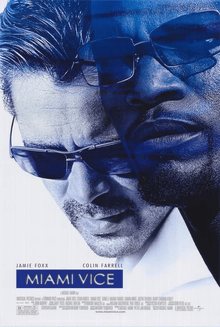
Miam Vice (2006) Poster.
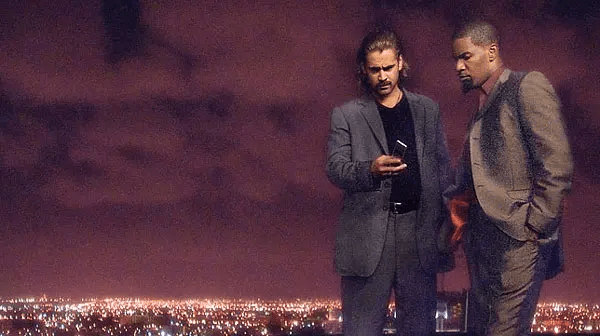
Nighttime scene example from Miami Vice (2006)
Though there are significant and early examples of digital being used in cinema like Jurassic park (1993) and Star Wars: Episode 2 – Attack of the Clones. However, I think taking a look at Michael Mann’s Miami Vice (2006) is interesting. He doesn’t use CGI to amplify the digital experience. however he uses digital as Wigley (2022) suggests “he became a digital poet of nighttime, using the advanced technology to capture the nocturnal atmospheric of Los Angeles and Miami in ways beyond the capabilities of traditional film”. With Miami Vice (2006) Mann showed the beauty of using Digital in the night to add atmosphere and almost give his film a life of its own (without any CGI). It captured the lights of the city while accounting for the hustle and bustle of a city with never sleeps. It represented an age where shooting in the dark was to become much easier and crucial in its impact for future films.
References
Rodowick, D.N. (2015) ‘What was cinema?’, in The Virtual Life of Film. Cambridge, MA and London, England: Harvard University Press, pp. 25–88. Available at: https://doi.org/10.4159/9780674042834-003.
Wigley, S. (2022) 10 great early digital films, BFI. Available at: https://www.bfi.org.uk/lists/10-great-early-digital-films.
 Digital Audiovisual Media Class Blog
Leave a comment