By G. Nanthinee Shree
The world knows S.S. Rajamouli as the prolific director who made the magnum opus Baahubali (2015) and the Academy Award-winning song “Naatu Naatu” from RRR (2022).
Prior to his international acclaim, he made a film that was ahead of its time, dabbling with both special effects and cinematic space long before it became mainstream in Indian cinema.
Eega (2012) is a film about a murdered man who reincarnates as a housefly and decides to avenge his death. He teams up with the woman he loved to make the murderer’s life a living hell.
Similar to the Fight Club scene mentioned by William Brown in his essay on Digital Cinema’s Conquest of Space (2013), this film has several scenes that illustrate how digital technology has changed film aesthetics in terms of the depiction of space. In this film, the main character, a housefly, truly exemplifies what Brown meant by the fact that space has been ‘conquered’ and that the camera passes ‘gaseously’ through those objects as easily as it does through ‘empty’ space.
For example, in one scene, the villain shoots his gun toward the housefly and we can see the close proximity in which the bullet misses the housefly. This is something we cannot perceive with the naked eye. Therefore, digital cinema allows us to transcend our limited human perception and experience what a housefly might go through when coming into contact with a bullet.
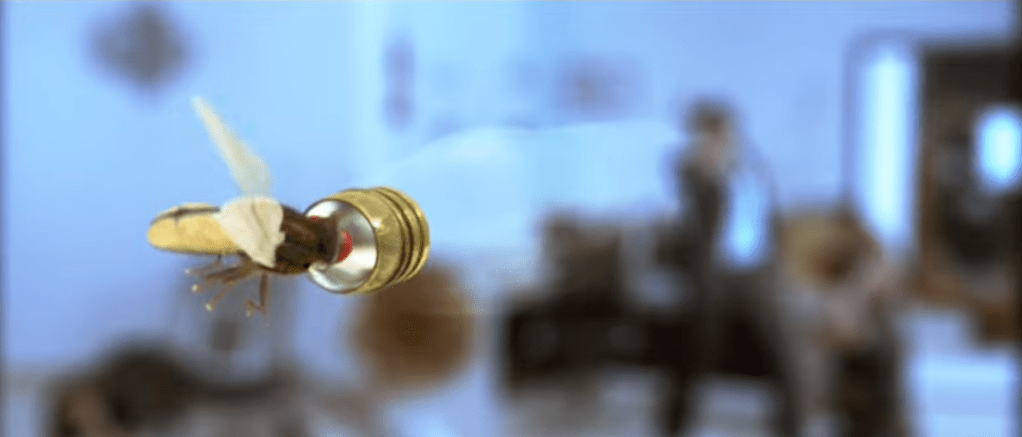
While the manipulation of space plays a huge role in establishing Eega as a vivid example of digital cinema, one cannot deny the special effects used in this film that cement its position as a post-cinema product. Special effects sequences move and spectators are put in motion relative to the world onscreen (Bukatman, 2003). In this film, the special effect sequences go so far as to enable us to see the world through the eyes of a housefly.
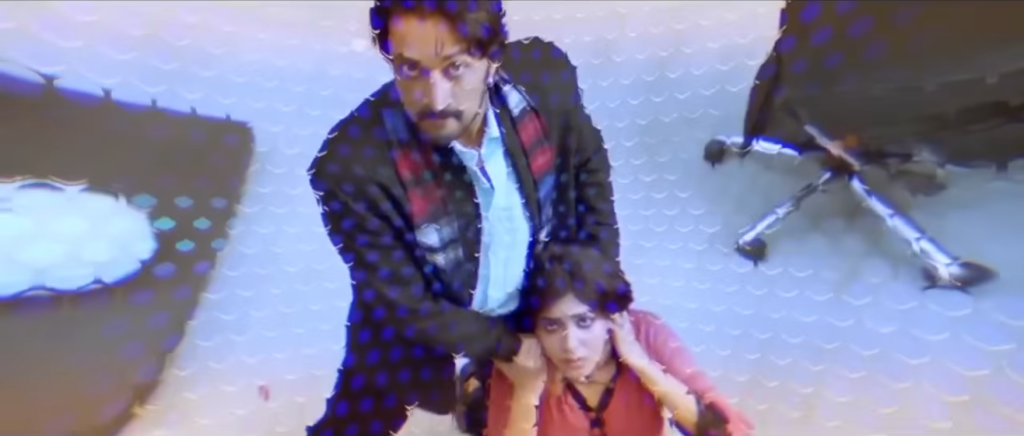

With the help of special effects, the shot/reverse shot in this scene takes a form that is post-human. This further allows a conceptual understanding of the world of the housefly that is unfamiliar to human beings. Without special effects, the details of the housefly as a main character and our empathy for the character would be practically impossible. How would the director be able to direct a real housefly and make it “emote” when necessary?
Ultimately, S.S. Rajamouli’s Eega (2012) does a commendable job in conquering cinematic space and leveraging the benefits of digital cinema and special effects to provide us with a post-cinematic experience. While it may seem laughable that the main character is a housefly, this is proof that digital cinema allows the stories of even the tiniest worlds to be told.
Works Cited
Brown, W. (2013). Supercinema: Film-philosophy in the digital age. Berghahn Books. (Specifically: Digital cinema’s conquest of space).
Bukatman, S. (2003). Matters of gravity: Special effects and supermen in the 20th century. Duke University Press.
Rajamouli, S. S. (Director). (2012). Eega [Film].
 Digital Audiovisual Media Class Blog
Leave a comment