By: Jimena Inda
Netflix and Bridgerton exemplify the reinvention of television in the streaming era, as theorized by scholars like Jenner (2018), Lotz (2017), and contributors to McDonald and Smith-Rowsey (2016).
Jenner describes Netflix as departing from traditional network models of scheduled, ad-interrupted broadcasting. Instead, Netflix releases full seasons (or, as with recent shifts, staggered parts) to enable flexible, viewer-driven consumption. Bridgerton (2020–present), produced by Shonda Rhimes, embodies this with its lavish Regency-era production: high cinematic values, opulent sets, costumes, and serialized romance arcs that unfold cohesively across episodes. Season 4 (2026), focusing on Benedict Bridgerton and Sophie Baek’s Cinderella-inspired story, debuted Part 1 on January 29 with massive viewership (39.7 million views in four days), followed by Part 2 on February 26—illustrating Netflix’s evolving strategies to sustain cultural buzz and retention beyond pure binge models.
Jenner’s emphasis on binge-watching as central to Netflix’s experience applies strongly. Viewers consume Bridgerton in marathon sessions, devouring steamy encounters, witty dialogue, cliffhangers, and dramatic balls without weekly waits. The platform’s on-demand access, seamless playback, and recommendations foster immersive, novel-like engagement, deepening emotional investment in character relationships and scandals.
Lotz conceptualizes internet-distributed television as portals, empowering user choice in vast, global libraries. Bridgerton thrives here, blending historical fantasy, modern romance sensibilities, and escapism—discoverable alongside diverse genres worldwide. Netflix’s data-driven approach amplifies its appeal.
The series also advances representation, using color-conscious casting to feature Black and Brown actors (e.g., Queen Charlotte, Lady Danbury, the Sharmas) in aristocratic roles, centering interracial romance, power, and ambition in ways legacy media rarely did.
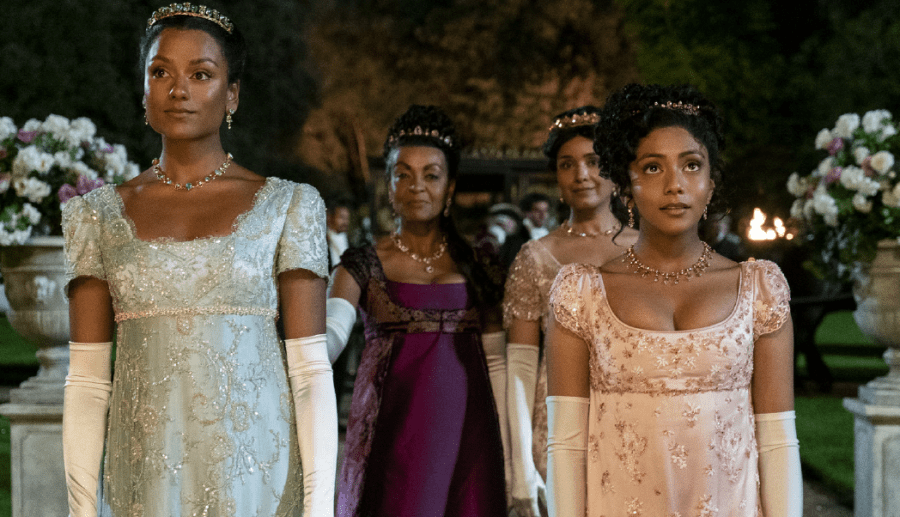
Overall, Bridgerton demonstrates how Netflix has transformed TV production, consumption, and cultural reach in a converged digital landscape.
Bibliography:
- Jenner, M. (2018) Netflix and the Reinvention of Television. Cham: Palgrave Macmillan.
- Jenner, M. (2016) ‘Is this TVIV? On Netflix, TVIII and binge-watching’, New Media & Society, 18(2), pp. 257–273.
- Lotz, A. D. (2017) Portals: A Treatise on Internet-Distributed Television. Ann Arbor: University of Michigan Press.
- McDonald, K. and Smith-Rowsey, D. (eds.) (2016) The Netflix Effect: Technology and Entertainment in the 21st Century. New York: Bloomsbury Academic.
 Digital Audiovisual Media Class Blog
Leave a comment