by Qingxi Yin(33808268)
While learning about Netflix, binge watching and internet-distributed television this week, I started thinking about another platform-based viewing experience that feels very familiar to me: Chinese short drama platforms. At first, these two forms seem completely different. Netflix is usually associated with high production value series, complex storytelling and long viewing sessions, while Chinese short dramas are often fast-paced, short-form and highly commercial. But, the more I thought about it, the more I realised that both operate within a similar platform logic. Both are designed not only to tell stories, but to shape how viewers spend time, attention and emotional energy.
Netflix encourages continuous viewing through features such as autoplay, full-season releases and personalised recommendation systems. Similarly, Chinese short drama platforms structure viewing through vertical scrolling interfaces, automatic episode transitions and constant narrative hooks designed to maintain viewer engagement. In both cases, viewing duration appears to be shaped by individual choice, but is simultaneously structured by platform design. As Jenner (2018) suggests, binge watching becomes normalised as a natural viewing habit rather than an imposed behaviour. At the same time, Lotz (2017) argues that internet-distributed television shifts viewing from fixed schedules to database-driven content selection, meaning that viewer “choice” is increasingly shaped by platform architecture rather than broadcast timing.
Another important similarity lies in affect-driven viewing patterns. Netflix binge watching typically creates long-duration emotional immersion, allowing viewers to remain within the same narrative world for hours at a time. Chinese short dramas operate differently, but they are equally affect-driven. Short dramas often rely on frequent emotional triggers such as conflict, betrayal, romantic tension or sudden plot twists. These emotional beats can appear every few minutes, or sometimes even more frequently. Although the pacing is different, both forms rely heavily on emotional engagement rather than traditional narrative progression.
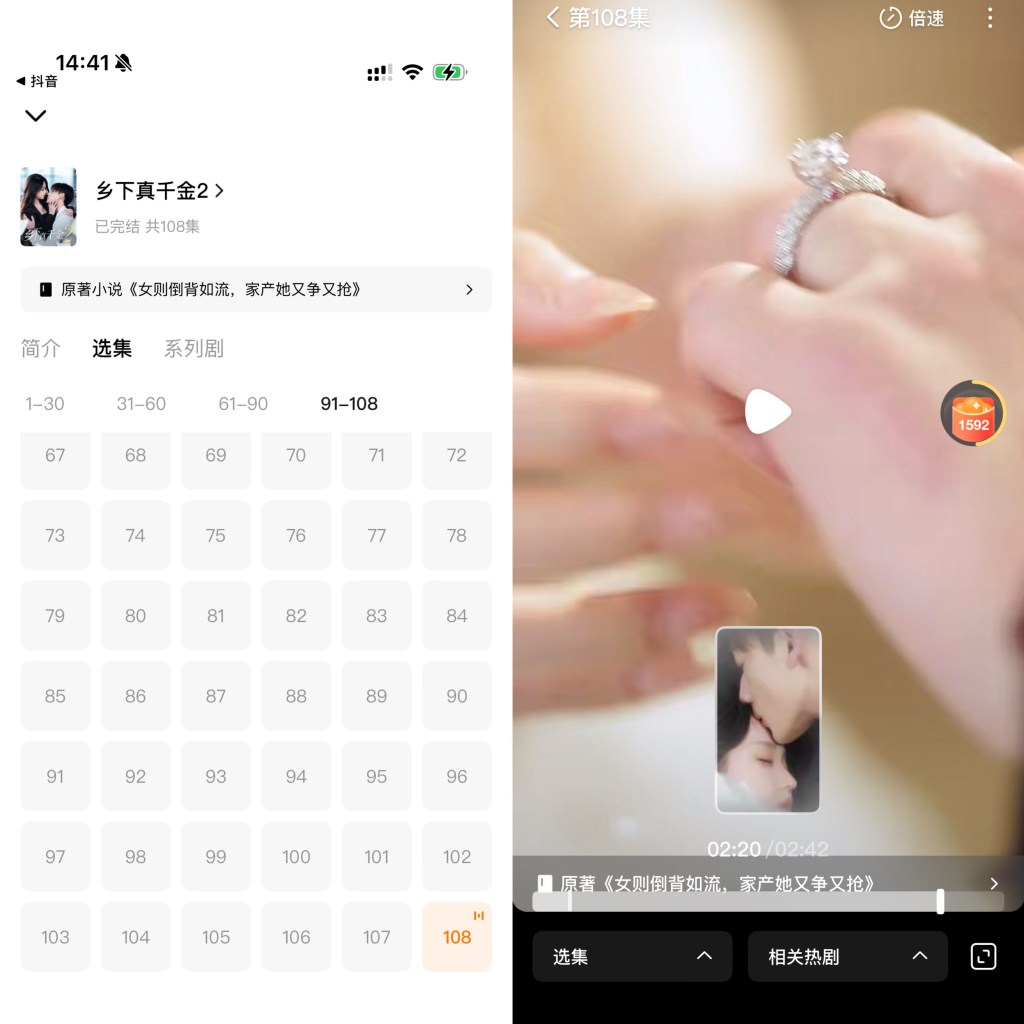
(As shown in the picture, Chinese short dramas typically contain a large number of episodes. A single series often includes more than 80 episodes, but each episode usually lasts only two to three minutes. Within this short duration, there are often one or two major plot twists or emotional triggers designed to maintain viewer engagement.)
Despite these similarities, the differences between Netflix and Chinese short drama platforms are equally significant. Netflix binge viewing is largely structured around long-term narrative immersion. Series are designed to keep viewers inside a single narrative world through complex character development and multi-episode story arcs. From this perspective, Netflix operates through what could be described as a narrative immersion model of platform viewing. By contrast, Chinese short dramas often prioritise rapid emotional stimulation. Rather than drawing viewers into a stable and extended story world, they frequently rely on repeated emotional loops to sustain viewing behaviour. These short affective cycles repeatedly reset the viewer’s emotional state, encouraging continuous consumption. In this sense, Chinese short drama platforms can be understood as pushing platform viewing logic further, shifting from long-term immersion toward high-frequency affective stimulation. This model aligns more closely with an affective attention economy, where continuous emotional activation often becomes more important than slow narrative development.
Overall, comparing Netflix and Chinese short drama platforms highlights how platform media increasingly shapes not only what we watch, but also how we watch and how we feel while watching. Whether through long binge sessions or rapid short-form emotional loops, platform-based media increasingly operates through managing viewer attention, time and affect rather than simply delivering narrative content.
references:
Mareike Jenner (2018), ‘Introduction: Netflix and the Renvention of Television’, ‘Introduction: Binge Watching Netflix’, Netflix and the Reinvention of Television, pp. 1-31, 109-118.
Amanda Lotz (2017), ‘Theorizing the Nonlinear Distinction of Internet-Distributed Television’, Portals: A Treatise on Internet Distributed Television, https://quod.lib.umich.edu/m/maize/mpub9699689/
 Digital Audiovisual Media Class Blog
Leave a comment