Watching Source Code (2011), what stood out most was how the film feels less like a traditional narrative and more like a repeated game scenario. The eight-minute loop structure resembles a puzzle or video game level, where each restart offers new strategies and perspectives. Rather than progressing smoothly through a linear storyline, the film emphasises repetition, urgency, and experimentation, encouraging viewers to focus on experience rather than narrative certainty.
This structure reflects what Shaviro (2010) describes as post-continuity cinema, where continuity editing and spatial clarity are no longer the central organising principles. Instead, narrative becomes one element among many, while affect, sensation, and fragmented temporality shape the viewing experience. The repeated train explosions produce a rhythm of anticipation and disruption, aligning with the aesthetics often associated with chaos cinema, where intense spectacle challenges classical spatial coherence.
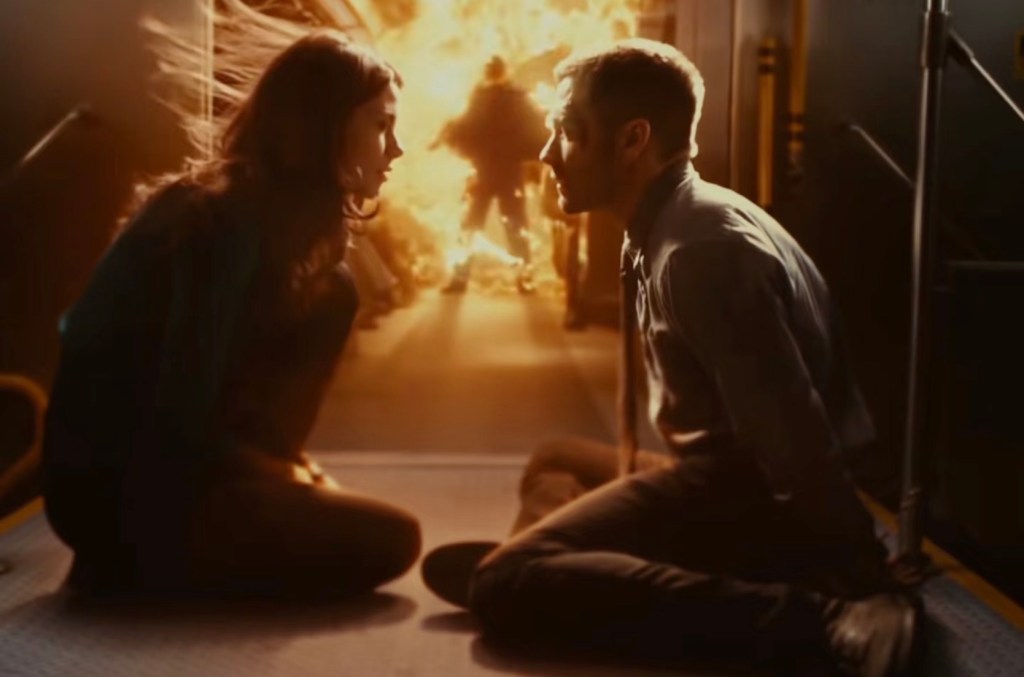
The simulated train environment also highlights how digital cinema reshapes our understanding of space. Although the setting initially appears realistic, it gradually becomes clear that the space operates as a programmable simulation. Brown (2013) suggests that digital cinema pushes beyond traditional spatial logic, and Source Code demonstrates this by presenting space as modular and repeatable rather than continuous in space.
Additionally, the protagonist’s fragmented embodiment reflects what Pisters (2012) calls the neuro-image, in whichconsciousness exists independently of a stable physical body. Rather than simply offering spectacle, the film uses digital structures and game logic to create new forms of perception, emotional engagement, and subjectivity, showing how post-cinematic cinema reshapes both storytelling and viewer experience.
Reference List
Brown, W. (2013) Supercinema: Film-Philosophy for the Digital Age. Oxford: Berghahn Books.
Bukatman, S. (2003) ‘The Ultimate Trip: Special Effects and Kaleidoscopic Perception’, in Matters of Gravity: Special Effects and Supermen in the 20th Century. Durham, NC: Duke University Press.
Pisters, P. (2012) The Neuro-Image: A Deleuzian Film-Philosophy of Digital Screen Culture. Stanford: Stanford University Press.
Shaviro, S. (2010) Post-Cinema: Theorising 21st Century Film. Winchester: Zero Books.
By Wenxin Zheng 33741930
 Digital Audiovisual Media Class Blog
Leave a comment