-
Digital Cinema: Creating Reality
The Gravity (2013) In present years, movies, films, series are all in post cinematic form. To be more specific, some films could also be called digital cinema as we are now in the digital age where special effects, computer-generated imagery (CGI), green-screen, etc. are being used to create more realistic reality in the industry. Beside…
-
The bad ending for Chaos Cinema: Skibidi Toilet
Skibidi Toilet is a massively popular web-series of Youtube 3D animated videos created by self-taught animator Alexey Gerasimov. Contrary to its innocuous, silly-sounding name, the series is chock full of nightmarish, grotesque visuals: contorted humanoid faces abruptly leap out at the camera (these are the titular main characters of the series), waging a war against…
-
Trans TV Unveiled: Navigating the Queer Aesthetic with Orange Is the New Black
In a world where contemporary television is constantly evolving, Michael N Goddard and Christopher Hogg argue that the rise of digital technologies has caused a shift in the ways that content is produced, distributed, and consumed, putting into question traditional concepts within television (Goddard and Hogg, 2018). They propose that these shifts are not isolated…
-
Streaming: The Move To Linear Scheduling
Jenner states that one of Netflix’s defining differences from broadcast Television is “abandon[ing] the idea of the linear television schedule: Netflix puts all episodes of one series online at once, resembling more models of book.” (2018, p4). Lotz also stresses the importance of Netflix’s non-linear content consumption, highlighting that Netflix did not start this habit;…
-
The Past Transforming to the Present
Post cinema combines real image and imaginary image of someone’s mind and memory, exploring the 21st century media, helping us to understand, share and reflect new forms of sensibility. As “film-making has been transformed” (Shaviro, 2010b), post-cinema is another technique of producing effect, and is both continuation and a break from the past, intertwining between…
-
Netflix and Binge-watching
Television shows change over time to better cater to the preferences of the audience, it uses new technology to attract more audiences. The audiences had to adhere to television networks’ schedules for decades. Nearly every television norm, including the length of a show, its frequency, and its content consistency, is created to accommodate a linear…
-
So Why Are You Still Watching?
The paradigm shift from traditional television to OTT entertainment has transformed our consumption habits. It has even introduced new terms like “binge-watch”, which was the Collin’s English Dictionary’s word of the year in 2015, into our daily vocabulary. Netflix, a pioneer in internet subscription services for television content, engineered the ‘season dump’ model, where instead…
-
Post-Continuity & Chaos Cinema
Post-continuity is an aspect of post-cinema, a concept coined by Steven Shaviro, in which, ‘a preoccupation with immediate effects trumps any concern for broader continuity—whether on the immediate shot-by-shot level, or on that of the overall narrative’ (Denson & Leyda, 2016, p51). It is prevalent in modern movies, especially the action genre, where scenes such…
-
Netflix and Stranger Things, A Match Made in Heaven
As mentioned in Netflix and the Re-invention of Television, Netflix has expanded massively across the world from 2014 and dropped large amounts of licensed content throughout 2016 in favor of its in-house productions or Netflix Originals (Jenner, 2023). Launched during this period, Stranger Things was a huge success in its debut season, and the series is considered one…
-
Post-cinematic Form: The glamour of CGI
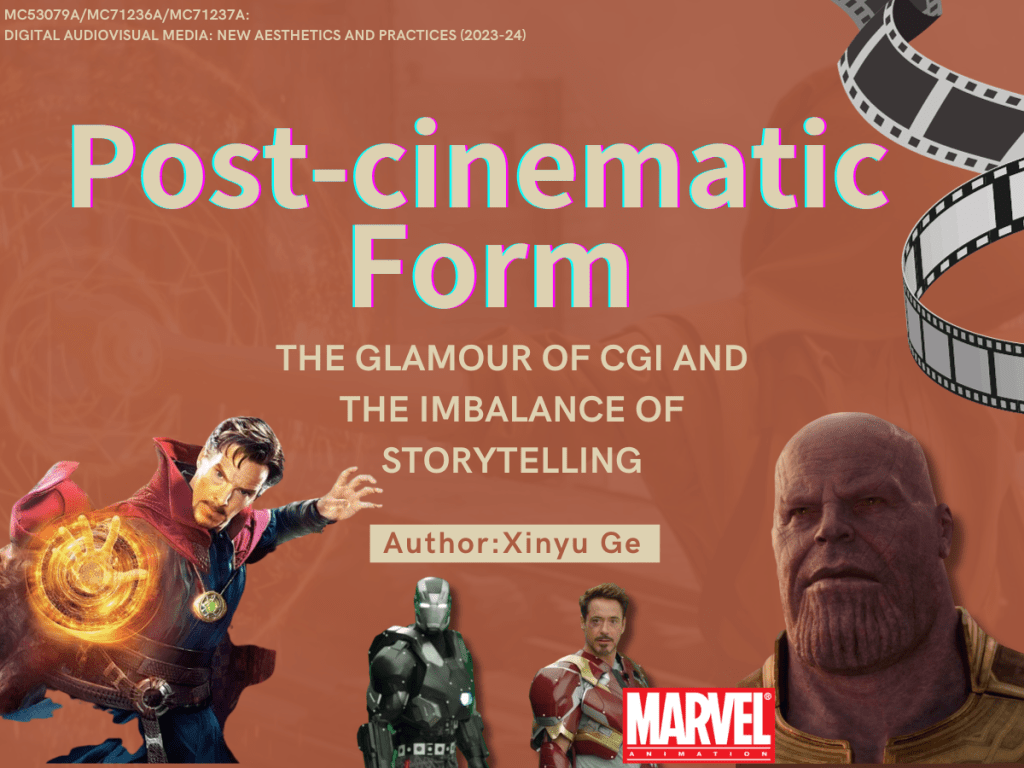
As a millennial, I didn’t live through the days of black and white TVs or the days when you needed to buy cassette tapes to play games. From the moment I was born, I was introduced to colourful digital television and the need to wear 3D glasses to watch 3D movies, the so-called post-cinema digital…
-
Subscribe
Subscribed
Already have a WordPress.com account? Log in now.
 Digital Audiovisual Media Class Blog